
In custom custom metal trophies projects, quotation outcomes are rarely driven by overall size alone. A larger award can sometimes be easier to manufacture than a smaller but highly sculptural one, while a visually compact design can become expensive if it uses heavy solid sections, difficult undercuts, extensive finishing zones, or labor-intensive assembly. For procurement managers, product developers, and award agencies, the practical question is not simply how big the trophy should be, but how form, mass, structure, finish area, and part architecture work together.
This article is a pre-quotation planning guide for teams comparing design directions before submitting artwork, reference images, or CAD for pricing. It focuses on the metal trophy design cost factors that most directly influence material usage, tooling strategy, weight, finishing effort, assembly load, and export handling. The goal is to help buyers identify which design features create real value and which ones mainly add manufacturing burden. Where project-specific feasibility depends on process, geometry, alloy, finish, or quantity, those details should be confirmed with the manufacturing team during evaluation.
Start With Target Look, Handling, and Budget Position
Before discussing structure or tooling, buyers should define three starting constraints: the intended visual impact, the in-hand feel, and the budget position of the program. These inputs affect nearly every later decision. A sports championship award, a corporate recognition piece, and a distributor program trophy may all require metal construction, but they do not necessarily need the same mass, silhouette, detailing level, or presentation format.
It helps to decide early whether the award should feel substantial and dense, intentionally lightweight for easier distribution, highly sculptural for visual drama, or clean and architectural for a precise branded look. These are different outcomes, and trying to pursue all of them at once often creates tension in design development. A concept that looks bold on screen may become awkward if the physical object feels top-heavy or too fragile in hand. Likewise, a desire for a premium feel does not automatically require maximum metal mass.
Premium appearance can come from silhouette, proportion, contrast, and finish selection rather than from weight alone. Strong negative space, controlled surface transitions, layered construction, and a well-matched base can often create more impact than simply increasing section thickness. Buyers who review size, shape, and structure options early usually make faster decisions about which design routes are commercially realistic.
Early alignment also reduces redesign cycles. Teams should agree on the target market, event purpose, shelf or stage presentation, shipping geography, and packaging expectations before requesting final pricing. A trophy designed for executive gifting may justify more finishing complexity than one intended for a large international awards program where freight efficiency and handling repeatability matter more.
Useful procurement prompts at this stage include: Which visual features are essential to the concept? What feeling should the award create when held? Where is budget flexibility limited? Is shipping sensitivity high? Will the award be produced as a one-program concept or as a repeatable platform with future variants?
Solid, Hollow, Shell, and Multi-Part Structures
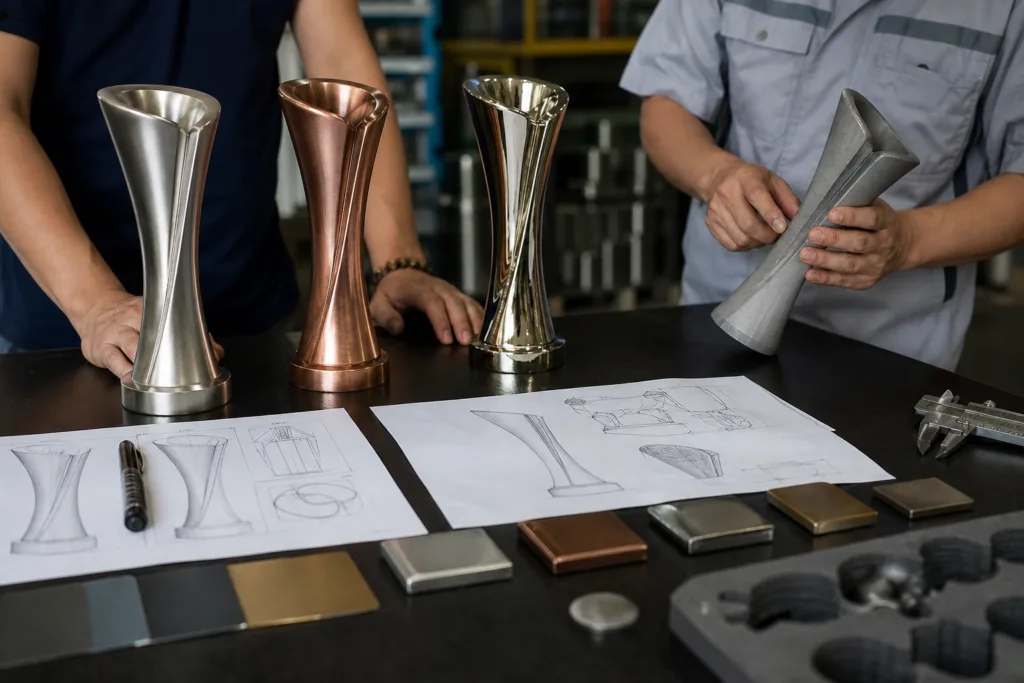
Structure is one of the most important custom metal trophy cost drivers because it influences material consumption, unit weight, tooling method, finishing accessibility, and assembly requirements at the same time. Buyers evaluating metal award manufacturability should compare the main structural routes in practical terms rather than assuming one method is always premium.
Solid cast forms are often used when the award is compact and the desired feel is dense and substantial. A solid structure can support a strong premium hand-feel and may simplify some aspects of visual continuity because the decorative form is one mass. However, as dimensions increase, solid construction usually raises material consumption, weight, and freight burden quickly. It can also create challenges in balance if the upper body becomes too heavy relative to the base.
Hollow constructions reduce mass while maintaining outer volume. They are useful when the concept must look large but cannot become impractical for handling or shipping. Hollowing can improve trophy weight reduction design, but it also requires the structure to be planned around wall behavior, joining logic, and finishing access. In cast-metal awards, uniform wall thickness and thin-wall-friendly geometry usually improve manufacturability and help control both weight and tooling complexity, as noted by the North American Die Casting Association at https://www.diecasting.org/web/Die_Casting/FAQ/Web/About/FAQ.aspx.
Shell-like decorative bodies are often selected for forms where the outside appearance matters more than heavy in-hand mass. A shell approach can create dramatic volume with lower metal usage, but the design must account for how the shell is supported, joined, and fixed to the base. These projects can be visually effective, yet seam placement and rigidity need careful review.
Multi-part assemblies allow larger scale, mixed materials, strong visual layering, and better orientation of complex forms during finishing. They are often a practical answer when a single-piece structure would be too heavy, too difficult to cast cleanly, or too costly to finish. Multi-part architecture is also common in die-cast metal trophies and mixed-base award concepts. The tradeoff is that each additional part can introduce more tooling coordination, fit-control requirements, and joining steps.
Structure selection should always be considered alongside intended size, base stability, and handling expectations. A compact commemorative award may benefit from solid mass, while a large event trophy may be better served by a hollow or shell-led structure with a weight-bearing base.
| Structure Type | Material Consumption | Weight Impact | Tooling Complexity | Finishing Effort | Assembly Load |
|---|---|---|---|---|---|
| Solid cast form | Higher | Higher | Medium | Medium | Lower |
| Hollow construction | Medium | Lower | Medium to higher | Medium | Medium |
| Shell-like body | Lower to medium | Lower | Higher | Medium to higher | Medium to higher |
| Multi-part assembly | Variable | Variable | Higher | Higher | Higher |
This matrix is directional, not absolute. Actual feasibility depends on geometry, process choice, alloy, finish system, and quantity band, all of which should be confirmed during project evaluation.
Size, Wall Thickness, Weight, and Balance Tradeoffs
Scaling a trophy upward changes more than height or width. It can alter total mass, center of gravity, base size requirements, carton design, protective packaging needs, and shipping efficiency. In bulk metal trophy design, these effects compound because the same weight decision repeats across every packed unit, every pallet, and every delivery lane.
Wall thickness is central to this discussion. Thicker sections can increase perceived solidity and structural confidence, but they also raise mass and may affect casting behavior, cooling, and finishing workload depending on the geometry. Thinner walls may reduce weight and support better logistics, yet manufacturable thickness ranges must be confirmed by factory process and shape. Buyers should avoid assuming that reducing thickness everywhere is the correct answer. The more useful objective is to place material where it adds visual or structural value and remove it where it mainly adds burden.
Common trophy weight reduction design strategies include selective hollowing of oversized volumes, redistributing mass into the base instead of the upper decorative form, simplifying upper geometry with less unnecessary depth, and controlling overbuilt sections that are not visible in normal use. These changes can preserve the intended silhouette while reducing material and improving balance.
Balance matters because a trophy that looks impressive but feels top-heavy creates handling risk. It may wobble, require a larger base than initially expected, or create instability during stage presentation and transit. In some projects, the most cost-effective change is not reducing the overall size, but revising where the mass sits. A broader or heavier base can stabilize the award, while a lighter upper body reduces leverage and handling strain.
Shipping context should guide these decisions from the beginning. If the award will be presented individually on stage, in-hand feel may matter more. If it will be shipped internationally in volume, excess weight becomes a recurring commercial issue. This is where buyers should connect aesthetic intent to logistics reality. The right question is not whether the award feels heavy, but whether it feels appropriately substantial for its purpose.
Practical buyer questions include: Does the award need to feel heavy in hand? Is freight sensitivity high? Will the trophy be displayed on a shelf, lifted for photography, or shipped globally in larger quantities? How much weight can the packaging concept reasonably support without increasing breakage risk or carton complexity?
Undercuts, Fine Details, and Finish Area Complexity
Many design teams focus first on shape complexity and overlook finish area complexity, even though both are major metal trophy design cost factors. Sculptural ambition affects mold development, casting difficulty, cleanup labor, and the consistency of plated, painted, or polished surfaces. A design can appear moderate in size yet still become expensive because the surface architecture is difficult to produce and finish cleanly.
Deep undercuts often increase mold complexity and may require more sophisticated planning for part release or part separation. Pierced areas can create visual lightness, but narrow bridges and internal edges may increase cleanup and inspection load. Thin projecting details, such as sharp fins, extended lettering, or raised emblems, can be vulnerable during casting, finishing, assembly, or packing. Sharp transitions and abrupt section changes can also increase manufacturing sensitivity.
Engraved content and textured surfaces need careful evaluation. Fine engraved copy, complex logos, and dense textures can look excellent in concept renders, but they may demand more cleanup, more controlled plating behavior, and more inspection attention. Mixed textures and recesses may also complicate paint application if certain areas require selective filling, masking, or edge clarity.
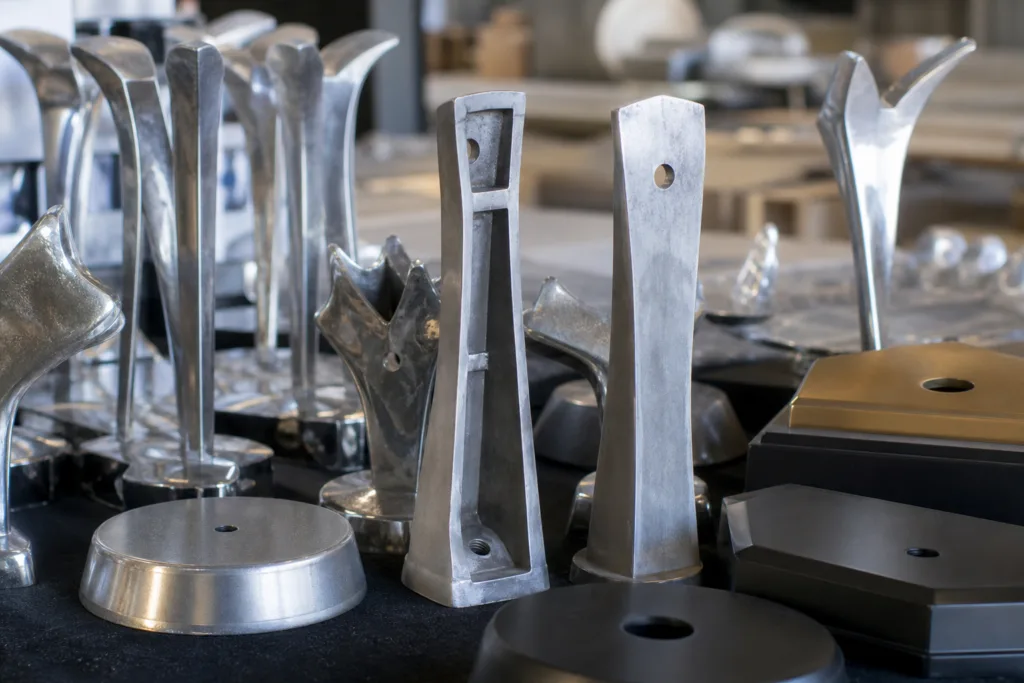
This is why finish area complexity often becomes a hidden trophy structure cost issue. A medium-sized award with multiple recessed zones, polished highlights, painted backgrounds, and contrasting plated regions can require more labor than a heavier but simpler object. Polishing time can rise when there are many small transitions. Masking steps can increase when finishes alternate frequently. Plating risk exposure grows when edges, recesses, or very fine details make surface consistency harder to control.
Buyers should compare high-detail surfaces against cleaner forms that create impact through proportion, contrast, and disciplined geometry. Not every premium award needs micro-detail. In many B2B award programs, controlled shape and finish contrast deliver stronger perceived value than excessive surface information.
Useful design review checkpoints include: Are logos and typography thick and clear enough for the selected process? Are edge definitions intentional rather than overly fragile? Do recessed zones need to be as deep or as numerous as shown in artwork? Can mixed-finish layouts be simplified without weakening the concept? Are texture areas adding brand value or only adding labor?
Part Count, Joining, Bases, and Personalization
Part count is one of the clearest custom metal trophy cost drivers because it affects tooling count, fit control, assembly labor, and defect risk all at once. A single-piece concept may appear efficient, but sometimes separating the design into logical components actually improves manufacturability. The key is to split the structure where there is a clear benefit, not simply because the artwork is visually segmented.
Common reasons to use multiple components include controlling part orientation during casting or finishing, creating material contrast, adding branding inserts, integrating stone or metal bases, or improving access to decorative zones. A multi-part build can also help a manufacturer maintain a cleaner finish on visible surfaces by treating parts separately before final assembly.
Joining decisions should be reviewed at a practical level. Alignment features need to support repeatable fit. Visible seams should be placed where they are least disruptive to appearance. Mechanical stability matters especially when upper decorative forms project outward or when the design includes thin contact points. The more parts involved, the more important tolerance control and assembly sequence become, and those details require confirmation for the specific project.
Base design deserves special attention because it is both a structural element and a cost element. A base affects stability, perceived value, packaging geometry, and presentation style. Larger or heavier bases can improve balance, but they also increase material and freight. Buyers comparing custom trophy bases should look at material choice, shape complexity, edge treatment, and how much mass is being carried in the base versus the upper body. In many cases, a well-proportioned base can help achieve a premium feel more efficiently than adding unnecessary decorative mass above it.
Personalization planning also matters early. Engraved plates, printed elements, and integrated name areas each support different levels of flexibility across award programs. An engraved plate may simplify recipient variation and reduce rework on the main decorative body. An integrated name zone can look cleaner, but it may limit flexibility or create finishing constraints. Printed or applied elements can support version control, yet they introduce another process step and another quality checkpoint.
For bulk programs, design architecture should account for commercial realities such as multiple recipient names, category variants, language changes, packaging inserts, and final assembly tracking. A visually elegant concept can become operationally awkward if the personalization method is not aligned with how the program will actually run.
Value-Engineering Questions Before Final Quotation
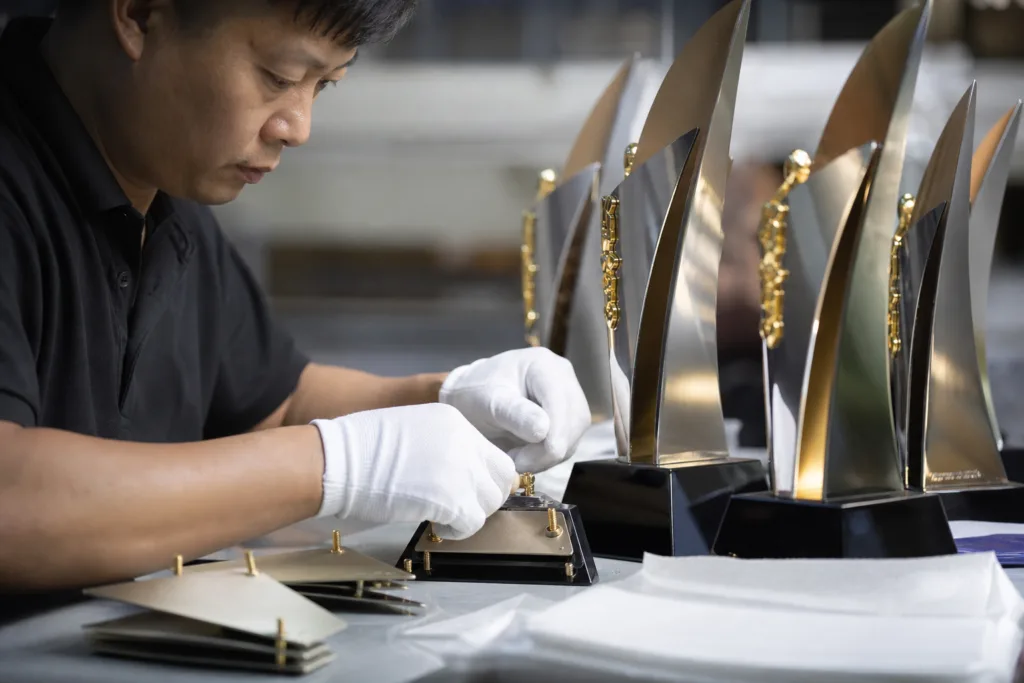
Before asking for final pricing, buyers should use a structured decision framework rather than sending only inspirational images and requesting a quote. The strongest RFQs define the visual concept and the commercial boundaries at the same time. This is where a pre-quotation custom metal trophies discussion is most valuable, especially when the project needs guidance on structure, finish, and assembly tradeoffs.
Start with perceived value. Which features directly support the award’s intended impact? If a bold silhouette already communicates prestige, perhaps dense texturing or deep recesses can be reduced. If visual depth is essential, can it be created through layering instead of solid mass? If the award needs contrast, can finish transitions be limited to fewer zones so masking and inspection become easier? If the program includes many name variations, can personalization be standardized in one location?
Buyers should prepare the following before requesting a detailed engineering review: artwork or CAD files, target size, intended quantity bands, preferred appearance, weight expectations, packaging context, and any non-negotiable visual features. Even approximate quantity bands are useful because the right tooling and construction strategy may vary by program scale. Production-specific details such as feasible wall sections, process routing, finishing sequence, and assembly methods should be confirmed during project evaluation and sample development.
Earlier manufacturing feedback typically reduces quotation revisions because it identifies lower-risk alternatives before tooling decisions are locked in. It also helps sourcing teams compare options on a more realistic basis. For example, a manufacturer may recommend shifting mass into the base, simplifying one undercut area, separating one decorative insert, or reducing finish transitions in order to improve manufacturability without changing the award’s core identity.
Useful value-engineering questions include: Which elements truly drive perceived value? Which areas can be simplified without changing the concept? Can decorative depth come from layered construction instead of extra thickness? Can finish transitions be reduced? Can the base do more structural work? Can personalization be standardized across the program? Are there shipping or packing conditions that should influence structure from the beginning?
For buyers evaluating drawings, reference images, and construction priorities, Me Trophy can be used as a manufacturing partner for engineering review, sampling, mold planning, casting, finishing, assembly, quality control, packaging, and export delivery. Project-specific feasibility, process details, and commercial terms should be confirmed directly for the program.
Conclusion
The best outcome in trophy structure cost planning usually comes from balancing appearance, manufacturability, and logistics instead of maximizing metal mass or decorative detail. A premium result can come from proportion, finish contrast, structural discipline, and stable presentation just as much as from heavier material content.
For buyers, two questions stay central throughout development: Which visual features are essential, and where can weight or complexity be reduced without weakening perceived value? Teams that answer those questions before RFQ stage tend to receive more useful quotations and face fewer revisions during sample development.
A practical design tradeoff matrix can help compare structure type, weight target, finish complexity, part count, and personalization strategy before artwork is finalized. Involving a manufacturing partner early makes it easier to compare alternatives, identify avoidable risk, and align the trophy concept with commercial reality.
Related Reading
- custom trophy cost guide
- tooling approval questions
- accurate trophy RFQ prep
- artwork and CAD requirements
- materials and finishes overview
Frequently Asked Questions
What design choice usually affects metal trophy cost the most?
No single factor always dominates, but structure, part count, finish complexity, and weight usually matter more than size alone. A moderate-size award with difficult undercuts, multiple finish zones, and extensive assembly can cost more to manufacture than a larger but cleaner design.
How can buyers reduce trophy weight without making the award look cheap?
Common approaches include selective hollowing, shifting mass into the base, simplifying oversized upper sections, and using proportion and finish contrast to create premium visual impact. The objective is to reduce unnecessary mass while preserving the silhouette and handling experience required for the program.
Are solid metal trophies always better than hollow or multi-part designs?
No. Solid structures may suit compact awards that need a dense in-hand feel, but hollow or multi-part construction can be more practical for larger forms, mixed materials, or freight-sensitive programs. The better choice depends on intended size, balance, finishing demands, and commercial priorities.
Why does finish area complexity change quotation results so much?
Complex finish areas can increase polishing time, masking steps, plating risk exposure, paint application difficulty, and inspection workload. Even when raw material use is moderate, a design with many recessed details, edge transitions, and mixed-finish zones may carry significantly more labor.
What should buyers prepare before asking for final trophy pricing?
Buyers should provide artwork or CAD, target size, expected quantity bands, preferred appearance, weight expectations, personalization needs, and packaging context. This information helps the manufacturer evaluate structure, finishing, tooling, and assembly options more accurately before quotation is finalized.