
Before you approve a tooling PO, separate the mold conversation from the part-price conversation. In a manufacturing workflow like mold development, the tool is not just a one-time charge; it defines geometry, repeatability, and the risk carried into sampling and production.
For OEM buyers, trophy mold cost should be read as a scope question: what is being cut, who approves it, who owns it, how long it is retained, and what happens if the design changes. Me Trophy approaches custom trophy programs as a manufacturer and project partner, covering mold development, casting, electroplating, painting, polishing, assembly, quality control, packaging, OEM/ODM, sampling, wholesale, and export delivery; project-specific terms still need confirmation.
Why Trophy Tooling Is Quoted Separately
Separate tool cost from piece price, finishing, and assembly
A clear quotation should split the mold from the finished award because each line item solves a different manufacturing problem. The tool creates the shape, the piece price reflects the casting and post-process work, and finishing or assembly may add their own process steps. When buyers see those items bundled too early, it becomes harder to compare suppliers on an apples-to-apples basis. In OEM manufacturing, a separate tooling line also helps teams decide whether the program is a one-time project, a recurring annual award, or a platform that may be reused for future versions.
Explain why die casting mold fee trophy is tied to design work, machining, and approval risk
The phrase die casting mold fee trophy is often shorthand for a larger scope that includes design interpretation, engineering review, machining, fitting, and trial corrections. A mold is not a generic commodity; it is built around the approved artwork, the release method, and the expected production route. If the buyer asks for tighter detail, more undercuts, multiple inserts, or special surfaces, the fee can move because the tool must absorb more machining hours and more approval risk before the first acceptable sample is reached.
Clarify what buyers should ask before accepting a split quotation
Before accepting a split quotation, procurement should ask whether the tool price includes initial design work, sample trials, revisions after first inspection, and any storage or retention obligations. It is also worth asking whether the quotation assumes a final production tool or a prototype tool. If those definitions are not written down, the buyer may later discover that the quoted piece price only applies after the tool is approved, or that the tool itself does not cover the level of detail the design team expects.
Geometry, Size, Cavities, Inserts, and Tool Complexity
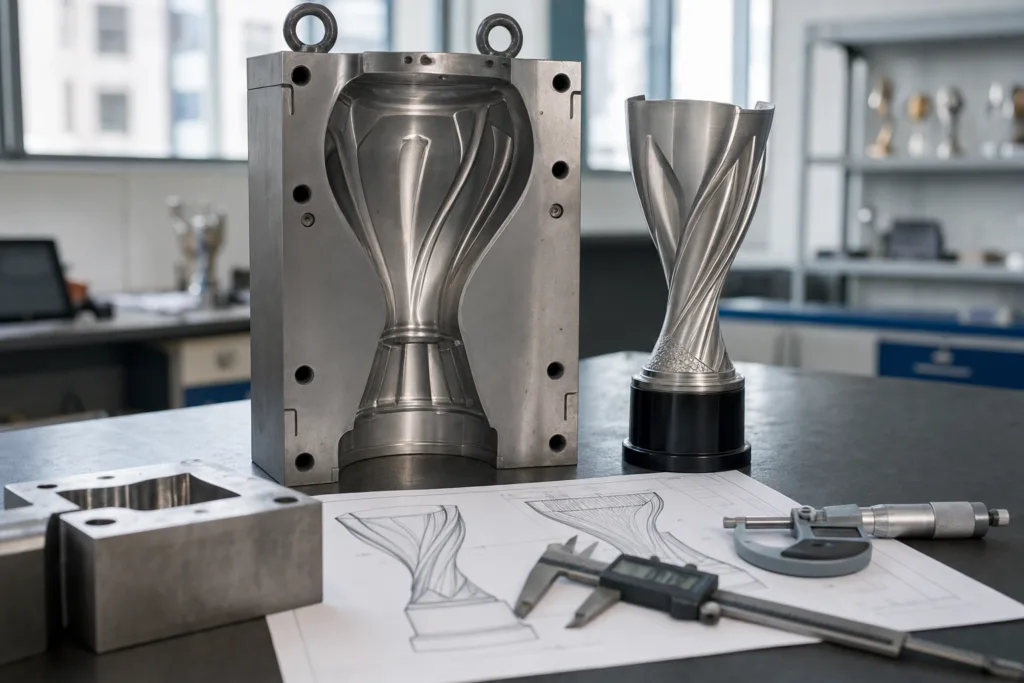
How part shape, undercuts, wall thickness, and surface detail affect trophy mold cost
Geometry is one of the fastest drivers of trophy mold cost because the tool must reproduce the shape reliably at the selected process window. Sharp relief, thin walls, deep recesses, hidden faces, undercuts, and layered decorative detail all increase risk. Even when the finished product looks simple in a presentation mockup, the mold may need more precise machining and more careful venting to release metal cleanly. In other words, shape complexity is not only an aesthetic issue; it is a tooling issue that affects how much work the manufacturer must do before the first stable run.
Why cavities, inserts, sliding features, and multi-part assemblies change tooling scope
Cavity count changes the scope because each cavity has to perform consistently, and each additional cavity can multiply setup and inspection effort. Inserts may be needed when a section of the design should be replaceable, isolated for wear, or created in a different finish. Sliding features and multi-part assemblies can also expand the mold scope because they require tighter coordination between the tool and the assembly steps that follow. Buyers reviewing design review comments should ask where the tool is simple, where it is modular, and where the manufacturer is carrying extra risk to keep the award manufacturable.
What drawing data and 3D files procurement should confirm before tool release
Before tool release, procurement should confirm which files are authoritative: 2D drawings, 3D CAD, artwork references, logo files, finish callouts, and any markups from the approval cycle. If the supplier is working from an incomplete package, the tool may be cut against assumptions that later become change requests. The safest approach is to require a documented sign-off set that identifies revision numbers, the approved finish standard, and any dimensions that are critical to the buyer. That file set should be attached to the PO or tooling agreement so the scope is traceable later.
Prototype Tooling Versus Production Tooling
Define the difference between sample-validation tooling and long-run production tooling
Prototype tooling is used to validate the shape, fit, surface, and assembly logic before the buyer commits to the final production path. Production tooling is built for repeatability and more stable output over a planned program lifecycle. The two are not the same, even if they look similar on paper. Buyers should not assume that a sample tool can carry the same duty as a long-run tool, especially when the design needs polish, plating, paint, or assembly steps that place different demands on the mold. A short validation program can justify a different tool conversation than a multi-order annual program.
How tooling amortization trophy should be discussed in relation to program volume and product lifecycle
Tooling amortization trophy is easiest to discuss when the buyer and manufacturer agree on the expected order pattern, the likely re-order window, and whether the design is stable enough to support reuse. The tool cost should be understood in relation to how many awards will be spread across that tool over time, not as an isolated line item. If a program is likely to be revised next season, the buyer may prefer a more flexible tool strategy. If the award will repeat with only minor changes, the same tool may deliver better lifecycle value. The key is to make the economic logic explicit before approval.
When a buyer should confirm whether the first tool is intended for sampling, pilot, or final production
This question should be settled before cutting begins. If the first tool is only for sampling, the buyer may accept a narrower scope so the team can validate aesthetics and fit quickly. If the same tool is intended for pilot production, the acceptance criteria must be stronger because the samples are already standing in for production intent. If the tool is meant for final production, then storage, maintenance, and reuse terms matter even more because the asset may carry program value for a longer period. For buyers evaluating die-cast trophies, that distinction can change both the approval pathway and the commercial risk profile.
Tool Ownership, Storage, Maintenance, and Reuse
Clarify trophy mold ownership in the PO or tooling agreement
Trophy mold ownership should be written clearly into the PO or tooling agreement, not left to implied practice. For formal contract language, procurement teams can use the same logic found in government purchasing references such as special tooling, which treats molds and dies as controlled manufacturing assets. The practical buyer question is simple: after payment, who owns the mold, who can authorize use, and what records prove title or custodianship? If ownership is unclear, later reorders, transfers, or program exits can become slower and more expensive to manage.
Ask how long the tool is retained, where it is stored, and what maintenance is included
Retention and storage matter because a mold is only valuable if it can be found, preserved, and used again. Buyers should ask how long the supplier will keep the tool, where it will be stored, whether preventive maintenance is included, and what happens if the tool sits idle for a long period. Trophy mold maintenance can include cleaning, lubrication, inspection, rust prevention, wear repair, and basic recordkeeping, but the exact scope must be confirmed. The more specific the retention language, the less room there is for dispute when a repeat order arrives after a long gap.
Confirm whether the tool can be reused for repeat orders, revisions, or future programs
Reuse is one of the main reasons buyers care about ownership. A tool that can be reused for repeat orders may reduce future setup effort, but only if the design still matches the approved artwork and the manufacturer is willing to release the tool under the agreed terms. Reuse for revisions is more delicate because even small changes to the logo, base shape, or finish can trigger rework. Reuse for future programs should also be clarified, especially if the buyer works with multiple brands or agencies. The contract should say whether the tool is dedicated to one program or may be reactivated for a new order family later.
Engineering Changes and Who Pays for Rework
Identify the types of changes that can trigger rework charges
Rework charges can be triggered by artwork edits, logo revision, size changes, base redesign, finish changes, cavity corrections, and any adjustment that affects the mold surface or assembly method. Even a change that looks cosmetic on a drawing may require re-machining or new inserts on the tool. Procurement should ask the supplier to classify changes by impact level: no-cost clarification, minor revision, or chargeable engineering change. That classification should be made before the tool is cut, not after the first sample is rejected.
Separate buyer-requested design changes from manufacturer-corrective changes
This distinction is critical. If the buyer changes the design after approval, the buyer should expect a formal rework discussion. If the manufacturer misses the approved specification, the correction should follow the manufacturer’s responsibility path. A procurement benchmark such as Changes and Changed Conditions is useful here because it reinforces the need for a written change gate and a clear cost-allocation process. In practice, the contract should say who authorizes the change, what evidence is needed, and whether schedule impact is part of the discussion.

Define the approval gate for any modification before cutting or re-cutting begins
No change should move forward without a written approval gate. That gate should identify the revised file version, the reason for the change, the expected cost effect, and whether the revision will affect the delivery path. If the project is managed through samples, the team should also define whether the revised tool must produce a new sample before production release. This step protects both sides from ambiguity: the buyer avoids paying for an unapproved change, and the manufacturer avoids building to a moving target.
Tooling Approval Questions for the Purchase Order
What exactly is included in the quoted tool
Ask for a written scope that lists the included mold body, cavity count, inserts, trial runs, sample corrections, and any post-approval tweaks. If the quote is vague, the buyer may assume a broader scope than the supplier intended. That is how disagreements begin. A precise scope also helps sourcing compare quotes from different partners without confusing a stripped-down prototype offer with a more complete production-ready tool.
Who owns the tooling and who controls release for reuse
The PO should state who owns the tool, who is allowed to release it for repeat use, and whether the supplier has any right to hold it for unpaid balances or inactive programs. This is not only a legal question; it is a supply continuity question. Buyers working with Me Trophy can place the question into the project file and confirm the commercial position before release. If reuse is important, the approval record should explicitly say so.
How long the tooling will be kept and under what conditions
Retention terms should answer three questions: how long the tool is kept, where it is stored, and what condition is required for continued use. If the tool is stored offsite, clarify who bears the storage risk. If the tool is idle, ask what maintenance cycle protects it. If a program is likely to return after a long interval, the buyer should also ask whether reactivation requires inspection or refurbishment before production can restart.
What triggers modification, repair, or replacement charges
The quotation should identify the triggers that turn normal use into a billable event. Those triggers may include buyer-requested artwork changes, damage caused by approved design changes, wear beyond routine maintenance, or replacement after a defined failure mode. If the supplier is charging for all modifications, that should be visible before approval. If some repairs are included, the boundary should be stated. The main point is to avoid a situation where every later adjustment becomes a fresh negotiation.
Which file formats, drawings, and sign-off records should be attached before approval
Attach the approved artwork package, the latest CAD or drawing set, the finish standard, and any sign-off record that proves the buyer has accepted the tooling scope. If the team is still refining details, the PO should say so and identify the revision status. If a supplier requests a final tooling quote after design confirmation, that is the right time to lock the file set and the approval chain. The record should be strong enough that a future reorder can trace the same decisions without guesswork.
Buyer Checklist for Comparing Tooling Quotations
Build a comparison table with fields marked confirm with Me Trophy
A simple comparison table helps the team focus on the same questions across suppliers. The goal is not to chase the lowest number on the page; it is to compare what each number actually includes. Use the table below as a procurement worksheet and mark every field that still needs confirmation with Me Trophy or with the other bidder.
| Quotation field | Why it matters | Confirm with Me Trophy |
|---|---|---|
| Tool scope | Defines whether design, machining, trials, and revisions are included | Yes or no before PO |
| Ownership | Determines who controls reuse and retention | Written title and release terms |
| Maintenance | Protects the mold against wear, corrosion, and storage damage | Included items and exclusions |
| Change control | Sets the process for buyer edits and corrective rework | Approval gate and charge rules |
| Retention period | Shows how long the tool can support repeat orders | Storage term and condition |
| File package | Proves which drawings and revisions define the approved tool | Named file list and revision numbers |
Compare scope, ownership, maintenance, change-control, and retention terms instead of price alone
The cheapest quote can be expensive later if it leaves out ownership, storage, or rework responsibility. Likewise, a slightly higher tooling fee may be the better commercial choice if it includes clearer retention and fewer ambiguity costs. Buyers should score each quotation against the same contract questions, then compare the total risk of the program. That is the most practical way to evaluate custom trophy tooling cost without confusing a narrow tool quote for a complete project offer.
Bridge to Mold Development Workflow

Introduce the physical workflow behind mold development, casting, electroplating, painting, polishing, assembly, and QC
The tooling discussion becomes easier when it is linked to the real production path. A custom award does not stop at the mold; it moves through a casting workflow, then into electroplating, painting, polishing, assembly, quality control, packaging, and export handling as needed. That is why the mold should be treated as a project asset rather than a standalone purchase. If the tooling scope is weak, every downstream process inherits the weakness. If the scope is clear, the rest of the manufacturing chain has a better chance of running to the approved plan.
Point readers to the tooling-review CTA and project consultation path
For buyers building a new award program, the next step is usually a design package review followed by a tooling quotation that matches the approved scope. Me Trophy can support that review as a manufacturer and project partner, but commercial terms, retention language, and any project-specific service commitments should be confirmed directly. If your team is comparing suppliers, use the same checklist, attach the same file set, and ask the same ownership questions before you approve the PO. That is the most reliable way to reduce surprises before cutting starts.
FAQ
What is usually included in trophy mold cost?
It usually covers the approved tool scope, such as cavity work, inserts, machining, fitting, and trial activity that is part of the agreed mold build. Buyers should confirm whether artwork changes, sample iterations, storage, and later repairs are included or billed separately.
Who should own the trophy mold after approval?
The PO or tooling agreement should say this directly. Ownership should not be assumed from payment alone. Buyers should confirm who holds title, who can authorize reuse, and what happens if the tool is transferred, idle, damaged, or scrapped.
When does tooling amortization trophy become useful in buyer review?
It becomes useful when the team is deciding whether the tool will support one short order, repeated seasonal orders, or a longer product life. The more stable the design and the more likely the repeat business, the more important it is to discuss how the tool cost is spread across the program lifecycle.
What changes typically trigger mold rework charges?
Artwork edits, logo revisions, size changes, base redesign, surface detail changes, and approval-stage corrections can all trigger rework. The quotation should say whether the buyer or the manufacturer is responsible for each type of change before any cutting or re-cutting begins.
What records should be attached before tooling approval?
Attach the approved drawing or CAD set, the artwork files, finish callouts, the revision number, and the sign-off record that shows who approved the scope. The more complete the record, the easier it is to manage reuse, reorders, and change control later.