
For B2B buyers, trophy weight specification should be treated as a design and procurement requirement, not a vague request for something that feels “heavier.” A well-written specification helps teams define a target weight and an acceptable range that support brand perception, recipient experience, structural stability, freight planning, and reorder repeatability. This matters whether you are sourcing executive awards, sports cups, or custom metal trophies for a global event program. The right answer is rarely maximum mass. It is purposeful mass, allocated to the right places and confirmed through engineering review and approved samples.
Because every project combines different materials, dimensions, wall sections, bases, decorative parts, finishes, and packaging methods, exact numeric ranges should not be assumed from generic market habits. Instead, they should be confirmed with the manufacturer during concept review, sampling, and approval. That approach reduces avoidable cost, handling issues, and production variation later.
Why weight matters for the recipient and the brand
Weight influences how an award is perceived the moment it is picked up. In ceremony settings, recipients and presenters quickly notice whether the piece feels substantial, awkward, light for its size, or unexpectedly difficult to hold. For procurement teams, that means weight is not just a physical property. It is part of the brand experience.
Common business reasons to specify weight include:
- Premium feel: A certain level of perceived substance may align with a high-value brand message.
- Ceremony presence: The award should feel confident in hand during presentation, photography, and media use.
- Handling comfort: The piece should not create unnecessary strain for one-hand lifting or handoff.
- Display confidence: A stable, grounded trophy often feels more credible on a desk, shelf, or plinth.
- Tier differentiation: Gold, silver, winner, finalist, or executive tiers may justify different target impressions.
However, buyers should ask a critical question early: is heaviness truly a brand requirement, or just an assumption? In many projects, perceived value comes more from proportions, detailing, finish quality, and balance than from added mass alone. A trophy can feel premium without becoming inefficient to manufacture or expensive to ship.
A practical approach is to document the intended impression for each award tier. For example:
- Executive award: substantial, calm, desk-display oriented
- Championship trophy: celebratory, stable, two-hand presentation friendly
- Recognition award: refined, comfortable, efficient for larger event quantities
This kind of language helps design, sourcing, and manufacturing teams align before numbers are discussed.
Separate total weight from weight distribution
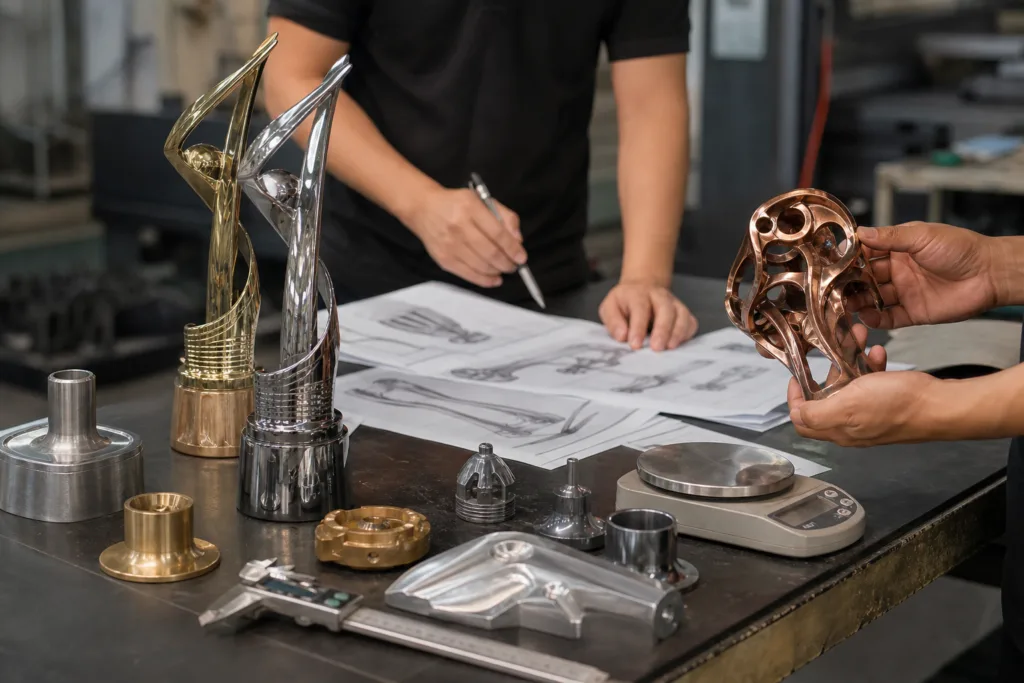
Total mass does not fully determine quality perception. Trophy balance specification is just as important. A well-balanced award often feels more premium than a heavier trophy with poor grip, a high center of gravity, or an unstable base. As NASA explains, the center of gravity affects how stable and balanced a trophy feels because it reflects where weight is actually located.
For buyers, the practical lesson is simple: a trophy should be assessed in the way it will actually be used.
Key balance factors to review
- Center of gravity: Is mass concentrated too high above the hand or base?
- Top-heaviness: Does a large decorative head, cup, or figure make the trophy feel unstable?
- Grip comfort: Where will the recipient naturally hold it, and does it feel secure?
- Base stability: Does the base provide enough support for display and handoff?
- Presentation motion: Can the trophy be lifted, turned, and photographed without wobble?
In early concept work, teams should review body-to-base weight allocation rather than discussing only overall grams or kilograms. This is especially important for tall trophies, narrow silhouettes, and mixed-material designs. If a design intent requires visual height, the answer may be smarter mass placement, not simply more metal everywhere.
Me Trophy can support this review as a manufacturing partner by assessing how body geometry, base construction, and assembly choices affect practical balance in production. For many projects, a focused discussion of design choices that affect weight is more useful than debating absolute heaviness.
Use target, range, and critical component controls
A reliable trophy weight specification is usually written in three layers:
- Target total weight: the intended finished-product weight used for design direction
- Acceptable finished-product range: the variation band that is acceptable after sample approval
- Critical component controls: separate controls for components that strongly affect stability, handling, or premium feel
This structure is better than a single fixed number because it reflects manufacturing reality. Casting, machining, assembly, inserts, electroplating, paint build, polishing, and base construction can all influence final mass. Metal award weight tolerance should therefore be confirmed for the specific design, process route, and assembly method rather than copied from generic assumptions. For die-cast parts, manufacturable geometry and realistic process controls should be reviewed against recognized die-casting design and tolerance guidance for metal award construction, then validated through sampling.
Practical specification wording examples
Use wording that gives clear direction without promising unsupported precision:
- Example 1: “Finished trophy target weight to be confirmed against approved engineering sample.”
- Example 2: “Acceptable finished-product weight range subject to manufacturer review, process feasibility, and approved sample confirmation.”
- Example 3: “Critical base mass to be controlled separately if display stability is required.”
- Example 4: “Packaging weight excluded from trophy weight specification unless otherwise agreed in writing.”
- Example 5: “Any change to material mix, insert strategy, plating, paint build, or base construction requires weight revalidation.”
This approach gives procurement teams a more useful control method than simply saying “make it feel heavy.” It also helps suppliers flag risk early if a target conflicts with manufacturability or handling.
Coordinate body, base, and internal structure
Weight control is shaped by the entire construction method. The body geometry, wall thickness approach, hidden supports, insert strategy, and base design all affect both custom trophy target weight and production feasibility. Buyers should review these factors together, especially for zinc alloy, copper, mixed-material, and die-cast trophy builds.
Construction choices that affect mass and usability
- Body geometry: Large hollow forms can look substantial without excessive mass, while compact solid-looking forms may become heavier than expected.
- Wall section approach: Section design affects both manufacturability and final weight; thicker is not always better.
- Internal supports: Hidden rods, reinforcement, or inserts may improve strength or balance but should be used strategically.
- Decorative attachments: Handles, emblems, medallions, and figures may add weight high on the trophy where they affect balance most.
- Base construction: Base dimensions, material choice, and internal weighting strongly influence display stability and hand feel.
This is where a project partner matters. The same visual concept can often be engineered in different ways. One version may hit the intended premium feel with better stability and lower freight burden; another may add metal in the wrong location, increasing cost without improving the experience.
When reviewing concepts, buyers should ask the manufacturer to separate visible design intent from hidden structural choices. For example, a heavier top ornament may look impressive in drawings, but the better solution could be a lower-weight upper body combined with a more purposeful base. If the award depends on a certain display footprint or ceremonial feel, early review of custom trophy bases is often the fastest way to improve outcomes.
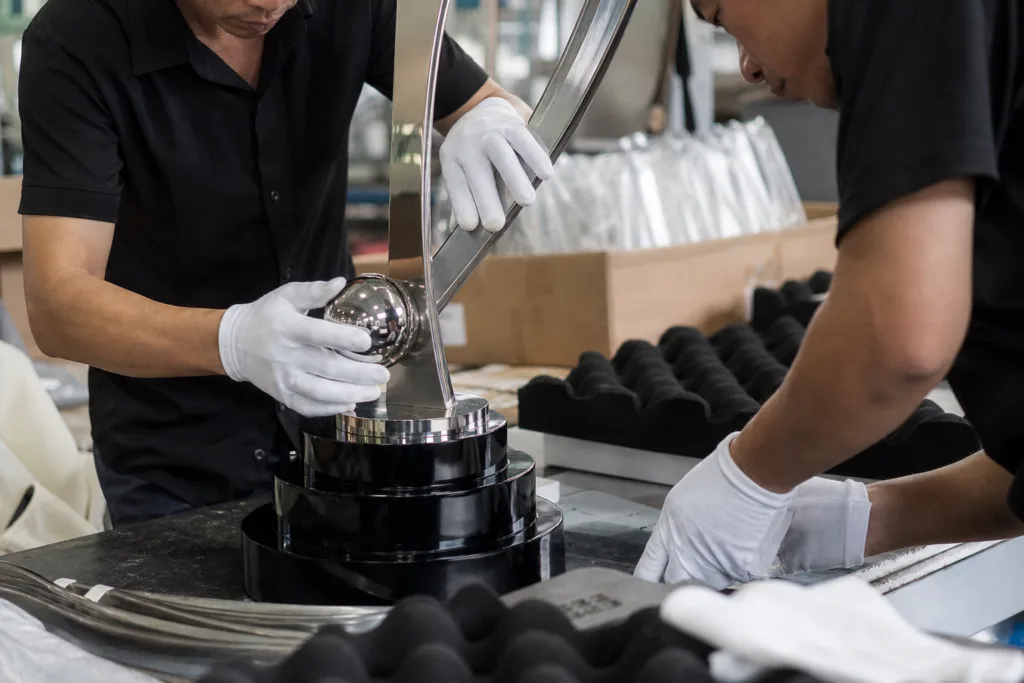
Likewise, geometry and manufacturability should be checked together. Early confirmation of size, shape, and structure helps prevent later redesign when the trophy turns out to be top-heavy, difficult to polish, or inefficient to package.
Validate handling, stability, and packaging
Weight should be validated in use, not only on paper. Sample-stage review should include handling tests, display checks, and packaging assessment. This is where many teams discover that an award feels acceptable in a CAD discussion but awkward in real-life presentation.
Sample checks worth including
- One-hand hold: Can most recipients lift and hold the trophy naturally for a photo?
- Two-hand hold: For larger awards, is the grip intuitive and comfortable?
- Handoff test: Does the award transfer smoothly from presenter to recipient?
- Tabletop stability: Does it sit securely on the intended display surface?
- Tipping resistance: Is the base proportionate to height and upper mass?
- Edge comfort: Are there pressure points or sharp transitions in holding areas?
- Carton protection: Does the packaging still protect the product once target mass is finalized?
Freight planning should also be reviewed at this stage. Heavy trophy shipping cost is not driven by mass alone. Package size matters too, because carriers may bill by actual weight or dimensional weight, whichever is greater. FedEx explains these carrier rules on dimensional weight and billable shipping cost. For procurement teams, that means adding unnecessary mass can increase cost, but increasing carton size can do the same. Weight specification and package geometry should therefore be discussed together.
If award mass changes, packaging may need adjustment as well. Foam density, insert design, carton grade, corner protection, and export packing method may all need review. This is especially relevant for international shipments and multi-location event distribution. Me Trophy can support these discussions through project-specific review of packaging and export delivery requirements, with final methods to be confirmed during development.
For tall or visually narrow awards, packaging and stability conversations should also connect back to base sizing for stability and shipping. In many cases, thoughtful base proportioning solves several problems at once: better display confidence, safer handoff, and less need for excessive hidden weighting.
Record the approved sample weight for reorders
Once a sample is approved, the project should not rely on memory or broad descriptions such as “same as before.” Reorder consistency depends on documenting what was actually approved and how it was measured.
What to record in the reorder control file
- Approved sample total weight
- Measurement method: scale type, whether weight was net or gross, and when it was measured
- Packaging inclusion or exclusion: confirm whether the carton, foam, bag, or label set was excluded
- Component allocation notes: body, base, inserts, decorative parts, and major hardware observations
- Base-specific requirements: especially if the base is the main stability control point
- Known acceptable variation: only what was reviewed and confirmed during sampling
- Change-control triggers: finish change, base revision, logo insert update, size revision, or construction change
This level of documentation matters because seemingly small changes can alter the final result. A different finish stack, revised plaque insert, thicker coating, alternate decorative top piece, or base redesign may change both total mass and balance. Reorders should therefore reference the approved physical sample and the approved specification notes together.
Near production approval, buyers can also revisit the product category page for custom metal trophies to align engineering review, sampling, and production communication in one project file.
Recommended asset section
For teams that manage multiple award programs, it is useful to create two internal working assets before RFQ or sample review:
- Weight-budget worksheet: a simple table that assigns intended mass across body, base, decorative attachments, hidden supports, and packaging assumptions
- Component allocation diagram: a marked drawing that identifies which areas are critical for premium feel, which areas are critical for stability, and which areas should be minimized for freight efficiency
These tools help procurement, design, and manufacturing teams discuss trade-offs with less ambiguity. They also make supplier comparison easier because each factory is responding to the same logic, not just a visual sketch and the word “heavy.”
| Control area | What to define | Why it matters |
|---|---|---|
| Total trophy weight | Target and approved reference sample basis | Aligns brand intent and reorder consistency |
| Base allocation | Whether base mass is a critical control | Improves stability and hand feel |
| Upper-body allocation | Maximum practical mass high on the trophy | Reduces top-heaviness and awkward handling |
| Packaging assumption | Excluded or included in weight discussion | Avoids RFQ and reorder confusion |
| Validation method | Sample checks, handling review, and weighing method | Creates objective approval criteria |
Procurement checklist and key questions

Use this checklist before finalizing a trophy weight specification:
- What premium impression should the award create?
- Will the trophy be lifted mainly with one hand or two?
- Is tabletop stability a critical requirement?
- Is freight sensitivity high for export or multi-location distribution?
- Have you defined a target weight and an acceptable range separately?
- Have you confirmed whether packaging weight is excluded?
- Which components most affect balance and must be controlled separately?
- Will base mass be treated as a critical requirement?
- Has the weighing method been defined for samples and reorders?
- What changes would trigger revalidation after sample approval?
Frequently asked questions
1. Should a premium trophy always be made heavier?
No. Premium perception often comes from balance, finish quality, proportions, and stability rather than maximum mass. A heavier trophy can still feel awkward or inefficient if weight is added in the wrong place.
2. How should we write a custom trophy target weight in an RFQ?
Use a target plus an approval-based statement, such as: target weight subject to manufacturer review and approved sample confirmation. If stability is important, note that base mass should be reviewed separately.
3. What affects metal award weight tolerance in production?
It depends on the project design, material mix, casting method, wall sections, inserts, finishing layers, assembly approach, and base construction. Exact achievable ranges must be confirmed with the manufacturer during engineering and sample approval.
4. Why does a trophy sometimes feel unstable even when it is heavy?
Total mass is only part of the answer. If too much weight sits high in the body, the center of gravity may be too high, creating a top-heavy feel and weaker display confidence. Balance and base proportion are critical.
5. How does trophy weight connect to shipping cost?
Higher mass can increase freight cost, but package size also matters because many carriers charge by dimensional or actual weight, whichever is greater. Trophy weight and packaging should therefore be reviewed together before production approval.
Conclusion
Effective trophy weight specification is about purposeful allocation, not maximum heaviness. The best results come when buyers define the intended impression, separate total mass from balance, control critical components such as the base, and validate handling, stability, and packaging through samples. Exact numeric tolerances and feasible ranges should always be confirmed for the specific project, because construction choices, materials, finishes, and packaging methods all influence the final result.
Me Trophy works as a manufacturing partner for custom award development, helping sourcing teams review construction options, develop samples, and confirm practical weight-control points before production. That makes it easier to align brand goals, engineering feasibility, freight planning, and reorder consistency without overengineering the award.