
metal casting capabilities should be reviewed early when making a trophy casting process selection, because geometry usually determines what is practical long before procurement compares tooling cost, finish plans, or sampling stages. For custom awards, there is rarely a universally best casting method for trophy production. The better question is which route best fits a specific form, surface target, assembly concept, repeat-order plan, and quality risk profile.
A disciplined custom award DFM approach starts with the shape itself and ends with a documented recommendation that can be checked by the manufacturer. That matters because a concept may look castable in CAD but become risky once split lines, polishing access, plating coverage, paint masking, hidden fasteners, or base integration are considered. Me Trophy can support this review as a manufacturing partner for DFM, sampling, casting, finishing, assembly, packaging, and export coordination, but factory-specific route feasibility, tooling structure, and validation sequence must be confirmed for each project.
This guide is designed for design engineers, sourcing teams, and technical buyers who need a practical framework rather than a generic process comparison. The goal is to help you convert geometry, finish, volume, and downstream operations into a defensible route recommendation with clear open questions for supplier confirmation.
Start With Geometry, Detail, Size, and Surface Goals
The first filter in metal trophy casting method selection is geometry. A trophy may include deep relief, sharp wings, thin spokes, enclosed windows, fine lettering, raised logos, curved silhouettes, perforations, asymmetrical mass distribution, and a decorative body that transitions into a separate base. Each of those features changes how metal fills the cavity, how the part is trimmed, and how much hand finishing will be required to achieve an acceptable appearance.
Key geometry variables include relief depth, wall transitions, edge sharpness, local thin-to-thick shifts, and the ratio between overall envelope size and the smallest decorative features. Fine text and crisp logo edges may push the design toward a route with better repeatable detail reproduction, while large sculptural forms with less critical edge definition may allow more flexibility. Trophy geometry casting decisions also depend on whether the visible face is mostly planar, highly contoured, or covered with recesses that are difficult to polish or plate uniformly.
Buyers should also separate appearance-critical surfaces from functional surfaces. A front medallion face may require excellent visual definition, while the back side may tolerate a more process-driven geometry if it is hidden after assembly. This distinction can expand process options and reduce unnecessary tooling or finishing complexity. If your team is still refining the concept, review design choices that affect manufacturability before requesting a final route recommendation.
Prepare this geometry evidence before asking a supplier to recommend the best casting method for trophy production:
- 3D CAD file with revision control
- 2D drawing with overall dimensions and key reference sections
- Target weight range, if known
- Identification of critical appearance zones
- Required surface texture or gloss expectations
- No-defect cosmetic areas where porosity, seam visibility, or polishing marks are unacceptable
- Logo, lettering, and emblem files in editable format
- Base concept, attachment direction, and center-of-gravity concerns
Complete engineering definition improves quotation quality and manufacturability review; NIST has published guidance supporting the value of complete digital product definition in supplier readiness and quoting workflows: complete drawing or model data improves casting quotation and manufacturability review.
Small design changes can materially improve feasible route options. Typical DFM adjustments include making wall sections more consistent where appearance allows, removing hidden detail that adds little brand value, splitting an over-complex body into two manufacturable parts, or separating the decorative body from the base so each component can use a more suitable process and finish path.
Evaluate Quantity and Repeatability Requirements

After geometry, assess how often the trophy will be reordered and how consistent future lots must be. A one-time event award, an annual championship series, a multi-region corporate recognition program, and a distributor-led repeat product line can justify very different process routes even when the visual concept is similar.
For technical procurement, the real question is not simply volume. It is the combination of annual demand, expected program duration, number of variants, and tolerance for visual drift between lots. If the design needs strong repeatability over multiple production cycles, reusable tooling and documented process controls may become more attractive. Industry guidance from NADCA is relevant here because die-casting standards address tolerance planning, GD&T, and design constraints for production geometries: NADCA die casting standards for tolerances, GD&T, and design guidance.
That does not mean die casting is automatically the answer. It means repeatability expectations should be stated explicitly. Prototype, sampling, pilot, and production thinking are different. A flexible route may be acceptable for early visual approval, while a more repeatable route may be preferred once artwork, geometry, and reorder plans are stable. Factory-specific economics, tooling amortization logic, and order-pattern assumptions must be confirmed with the manufacturer.
Ask procurement teams to request these points in writing:
- Recommended route and the geometry-based rationale behind it
- Expected repeatability controls for key dimensions and visible features
- Tool maintenance assumptions for future reorders
- How variant management will be handled if names, logos, or event years change
- What features are likely to vary visually from lot to lot
- Whether the route is intended for sample validation only or for ongoing production
If the design appears suitable for pressure-assisted or die-based production, it is helpful to check relevant die casting design guidelines before approving a tooling path. This helps technical buyers understand whether repeatability is being purchased through smart DFM or through avoidable tooling complexity.
Identify Undercuts, Hollow Forms, and Part Consolidation Needs
Undercuts and enclosed forms are often where a simple-looking trophy concept becomes difficult. Reverse angles behind wings, fully enclosed cavities, hidden attachment pockets, or a desire for a seamless hollow body can force more complex tooling, more visible split lines, or awkward hand finishing. In some cases, a one-piece concept looks elegant on paper but creates unnecessary manufacturing risk.
Part consolidation should therefore be treated as a DFM decision, not a design goal by default. A single cast body may reduce assembly count, but it can also reduce polishing access, increase defect exposure on visible surfaces, complicate plating, and make scrap more expensive if one local area fails cosmetic inspection. By contrast, a multi-part assembly may improve manufacturability if decorative and structural features are separated intelligently.
Examples where splitting the part may help include:
- A front medallion with fine detail attached to a simpler support structure
- A hollow sculptural shell joined from two halves with the seam placed in a low-visibility zone
- Decorative elements cast separately so painting and plating boundaries are easier to control
- A base interface built as a dedicated connector component rather than cast into a highly decorative body
Hidden joining methods, insert strategies, and fastener directions should be evaluated early. Ask the supplier where the split line would likely sit, whether inserts are needed, how internal cavities would be formed, and whether the chosen joining method could affect plating appearance, paint access, or long-term assembly consistency. In many trophy programs, a carefully planned multi-part construction reduces total risk more effectively than forcing an all-in-one casting.
Map Secondary Operations and Finish Requirements
Some geometries are technically castable but operationally poor once finishing begins. This is why casting feasibility trophy reviews should always map the full route from raw casting to packaged product. If drilling, tapping, welding, polishing, electroplating, painting, engraving, pad printing, adhesive bonding, or final assembly are required, each step must have physical access and process compatibility.
Start with finish-sensitive zones. Highly reflective plating on a raised emblem will reveal surface waviness, shallow defects, and aggressive polishing marks far more readily than a painted matte area. Sharp decorative edges may look excellent immediately after casting but soften significantly after grinding and polishing. Deep recesses may trap polishing compounds, produce non-uniform plating, or make paint masking too labor-intensive for stable production.
Build an operation map that includes:
- Raw casting state and trim points
- Required machining or hole-making operations
- Joining operations such as welding, adhesive bonding, or mechanical fastening
- Surface preparation sequence
- Polishing priorities by zone
- Electroplating, painting, and texture application sequence
- Nameplate or engraving integration
- Assembly to base and accessories
- Inspection checkpoints
- Protective packing and export carton requirements
This map often reveals route constraints earlier than the casting discussion alone. A narrow recess may be acceptable from a mold perspective but fail because a polishing wheel cannot reach it consistently. An integrated base socket may cast well but create masking challenges during painting. A large assembled trophy may meet cosmetic targets only if the decorative shell and structural support are finished separately, then joined later.
Technical buyers can use Me Trophy as a project partner to review secondary operations on cast trophies before approving a route. This is particularly important when custom bases, engraved plates, mixed finishes, or export packaging constraints are part of the final product definition.
Assess Tooling, Sampling, and Change Risk
Tooling risk is not only about complexity. It is also about how likely the design is to change after the tool concept is started. Awards often evolve late because logos update, event years change, sponsor marks are revised, dimensional proportions are adjusted for visual balance, or the customer changes the base after seeing the first sample. If geometry is still unstable, a route that is efficient for fixed production may become risky in practice.
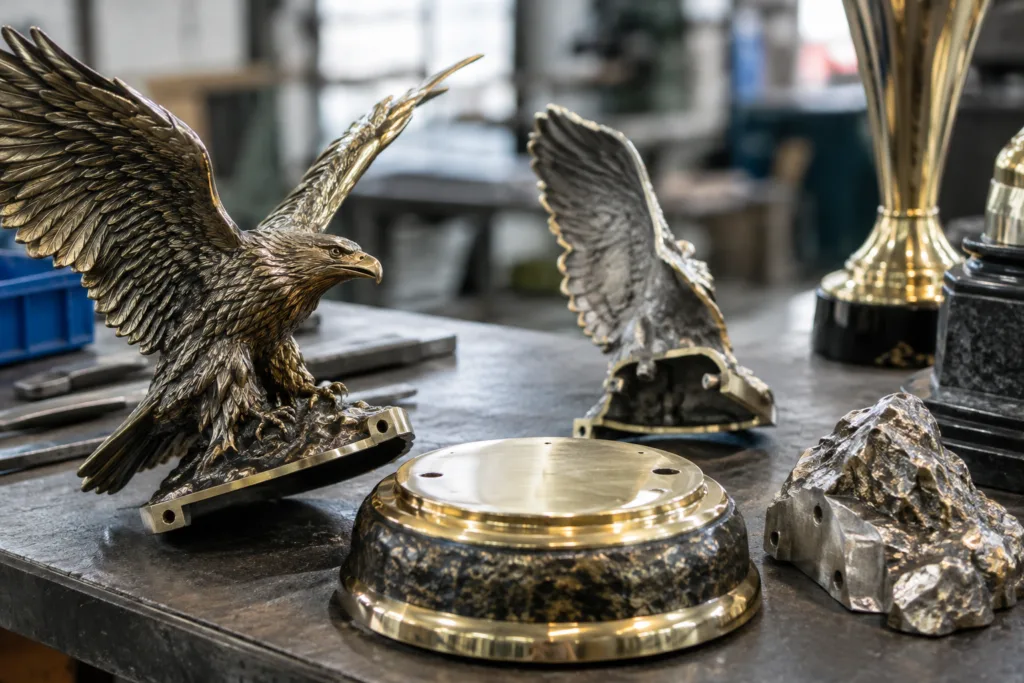
Design instability matters because changes can affect inserts, cavity layout, ejector positions, trimming tools, machining fixtures, and finishing jigs. Even small logo or lettering updates may have different implications depending on whether the feature is cast in, engraved later, or applied on a separate nameplate. Factory-specific tool design details and revision impacts must be confirmed during project review.
A practical DFM review list should cover:
- Whether geometry is frozen or still under active revision
- How revisions are named, tracked, and communicated
- Sample approval criteria for dimensions, appearance, and assembly
- Cosmetic acceptance standards by viewing distance and light condition
- Required pre-production checks before mass production approval
- Contingency actions if early samples show fill issues, shrinkage, seam visibility, or finish problems
When tooling development is part of the sourcing scope, ask for a documented review of mold development assumptions. Buyers should understand what is fixed, what can be adjusted by insert change, what would require major rework, and how sample findings will be fed back into the final production route. That protects both schedule planning and budget approvals without relying on unverified assumptions about lead time or revision cost.
Document the Recommended Process Route
Once geometry, finish, volume, assembly, and change risk have been reviewed, the result should be a written process recommendation rather than a verbal preference. This is the most practical way to convert custom award DFM into procurement evidence. The decision record does not need to be long, but it should be specific enough that engineering, sourcing, and the manufacturer are evaluating the same product definition.
A useful decision record includes these fields:
| Field | What to record |
|---|---|
| Part description | Short summary of the trophy body, base, and decorative elements |
| Critical geometry features | Fine lettering, undercuts, hollow zones, thin features, high-visibility edges |
| Target finish | Plating, paint, texture, polished areas, no-defect cosmetic surfaces |
| Expected order pattern | Sample, pilot, recurring reorder, annual event, variant mix |
| Secondary operations | Machining, joining, engraving, printing, assembly, packaging requirements |
| Tooling sensitivity | Likelihood of logo or geometry revision and tool-change impact |
| Sampling plan | Visual sample, engineering sample, finish sample, approval checkpoints |
| Recommended casting route | Preferred process with geometry-based rationale |
| Backup route | Alternative if the preferred route fails cost, finish, or timing review |
| Open technical questions | Points requiring supplier confirmation before release |
A geometry-to-process decision tree is often the most useful visual asset for internal approvals. It can summarize whether the form is detail-driven, undercut-heavy, finish-sensitive, reorder-critical, or revision-prone, then point to the most likely route and backup route. For broader context only, teams can reference Me Trophy’s existing die casting vs sand casting resource, but this article’s purpose is to structure a DFM decision rather than repeat a simple process-versus-process comparison.
Before commercial sign-off, return once more to Me Trophy’s metal casting capabilities so the documented recommendation can be checked against factory-specific route feasibility, finishing compatibility, assembly planning, sampling expectations, and export support requirements.
Procurement Checklist: What Evidence Is Needed to Select a Process?

Technical procurement teams can reduce back-and-forth by preparing a standard evidence pack before requesting a casting recommendation. This shortens quoting cycles and makes supplier feedback more comparable.
Buyer evidence checklist
- 3D model with latest revision number
- 2D drawing with target dimensions and key reference views
- Cosmetic priority zones and no-defect areas
- Finish specification, including plating, paint, polish, or texture targets
- Logo and artwork files in editable format
- Assembly concept and joining expectations
- Base material, size, and mounting details
- Expected order pattern and likely reorder frequency
- Packaging constraints for storage, shipping, or presentation
- Compliance or market requirements, if applicable
- Approval criteria for samples and production
What to ask the manufacturer to confirm
- Route feasibility based on actual geometry
- Likely tooling concept and split strategy
- Sampling sequence and approval gates
- Finishing compatibility with the chosen route
- Assembly method and hidden-fastener practicality
- Inspection checkpoints for dimensions and cosmetics
- Export packaging considerations for the finished award
If buyers need support preparing a review package, Me Trophy’s design evaluation process can help align geometry, process assumptions, and sourcing questions before tooling decisions are made.
Design Changes That Can Open Better Manufacturing Routes
Many trophy programs become easier to source when the design team is willing to adjust low-value geometry that does not materially affect brand impact. The aim is not to simplify the award into a generic shape. It is to remove features that generate disproportionate process, finishing, or scrap risk.
Common DFM opportunities include:
- Reducing inaccessible recesses that are hard to polish or plate consistently
- Improving draft on hidden or low-visibility walls where appearance allows
- Separating decorative medallions from structural sections
- Simplifying hidden back-side geometry that adds mold complexity without visible benefit
- Moving event-year or recipient-specific information to plates or bases instead of casting it into the main body
- Standardizing connection features across variants
- Aligning finish boundaries with part splits so masking becomes easier and visual transitions look intentional
These changes can improve route flexibility, sample success, and reorder consistency without weakening the award’s visual message. They are best reviewed jointly with the manufacturer so geometry, finishing, assembly, and packaging are considered together rather than in isolated departmental decisions.
Conclusion
The best casting method for trophy production is not a default preference for one process over another. It is the result of a geometry-led DFM decision that also accounts for finish targets, repeatability needs, secondary operations, tooling sensitivity, and sourcing risk. When buyers document those inputs clearly, process selection becomes more transparent and easier to validate.
For international B2B programs, the most reliable path is to use a written decision framework, record the preferred route and backup route, then confirm factory-specific feasibility with a qualified manufacturing partner. Me Trophy can support that evaluation across casting, tooling, finishing, assembly, sampling, packaging, and export planning, while process limits, tooling details, and project-specific production assumptions should always be confirmed for the actual design.
Frequently Asked Questions
1. What is the first step in trophy casting process selection?
The first step is to review geometry, not price. Relief depth, fine detail, wall transitions, undercuts, and visible surfaces usually determine which routes are practical before tooling or finish cost can be assessed.
2. Can one-piece trophy designs increase manufacturing risk?
Yes. A one-piece concept may reduce assembly count, but it can also create harder tooling, poorer polishing access, more visible seam risk, and lower finishing control. In many cases, a multi-part design is more manufacturable and more stable.
3. How do finish requirements affect the casting route?
Finish requirements can change the preferred route because polished, plated, painted, or mixed-finish surfaces need access for preparation and defect control. A shape that is castable may still be impractical if finishing cannot be done consistently.
4. What should procurement ask a trophy manufacturer to confirm?
Procurement should ask the manufacturer to confirm route feasibility, tooling concept, likely split lines, sampling sequence, finishing compatibility, assembly method, inspection checkpoints, and export packaging considerations for the final product.
5. When should a backup casting route be documented?
A backup route should be documented during DFM review whenever geometry is still evolving, samples may reveal risk, or the preferred route depends on assumptions about finish, tooling, or reorder plans that have not yet been fully confirmed.