
An outdoor sports trophy should not be specified by appearance alone. A polished sample may look excellent under showroom lighting yet perform very differently during a rainy award ceremony, a humid season of event reuse, or a period of trophy outdoor display. For procurement teams, sports organizations, and sponsors, weather resistance is better understood as a system: exposure duration, substrate metal, outdoor award finish, joint design, base stability, handling, storage, and the level of evidence required before approval. That is why buyers should define use conditions before final artwork, sample approval, or mass production. If your project begins with branded custom sports trophies, the next step is translating event conditions into manufacturable specifications.
For B2B buyers, this is less about finding a universally “weatherproof” award and more about asking the right questions. A weather resistant trophy for a one-hour outdoor ceremony may be specified differently from an outdoor championship award that is transported repeatedly, handled by multiple winners, and displayed between events. Me Trophy supports this process as a custom trophy manufacturer and project partner through mold development, casting, metal finishing, assembly planning, quality review, packaging, OEM/ODM coordination, sampling, and export delivery. Exact performance claims, test data, lead time, MOQ, warranty, or certification details must be confirmed for the specific project.
Define Exposure Duration and Storage Conditions
The first procurement decision is not color or shape. It is exposure duration. A trophy used for a short outdoor presentation can tolerate a different risk profile than one displayed outdoors for weeks, moved from stadium to stadium, or stored in damp venue rooms between events. Sun, rain, humidity, salt air, polluted urban air, temperature swings, lawn irrigation, poolside chlorine, fertilizer drift, and frequent handling can all change what matters most in the specification.
Buyers should classify use into practical categories: momentary exposure, intermittent exposure, seasonal event use, or extended display. Momentary exposure may prioritize visual impact and handling safety. Intermittent use may place more emphasis on cleaning, transport abrasion, and moisture recovery after each event. Extended display raises more questions about corrosion progression, UV effect on coated surfaces, water entry at joints, and base interaction with wet surfaces.
A simple exposure questionnaire helps prevent design mistakes before the project is frozen. Ask:
- Is the trophy used only during a ceremony, or will it remain outdoors after the event?
- Will awards be stored indoors between uses, and if so, under what humidity conditions?
- Are they transported in fitted cases, cartons, or loose event bins?
- Will the trophy be touched repeatedly during photography, media access, or sponsor activations?
- Is the venue coastal, tropical, cold, urban, poolside, or near chemical exposure such as fertilizers or cleaning agents?
- Will rainwater, sprinkler water, or condensation contact the award during or after use?
A useful RFQ attachment is a risk matrix linking environment type to design precautions. For example, inland short-duration events may focus on stable footing and wipe-clean finishes, while coastal or high-humidity use may require closer review of coating stack, edge protection, drainage, and hardware selection. The objective is not to promise indefinite life. The objective is to define the real use case clearly enough for engineering, finish selection, and sample review.
For buyers managing recurring tournaments, it is often helpful to compare requirements with broader championship trophy durability considerations, especially when the same award must survive repeated transport and annual handling.
Choose Materials and Finish Systems for the Environment
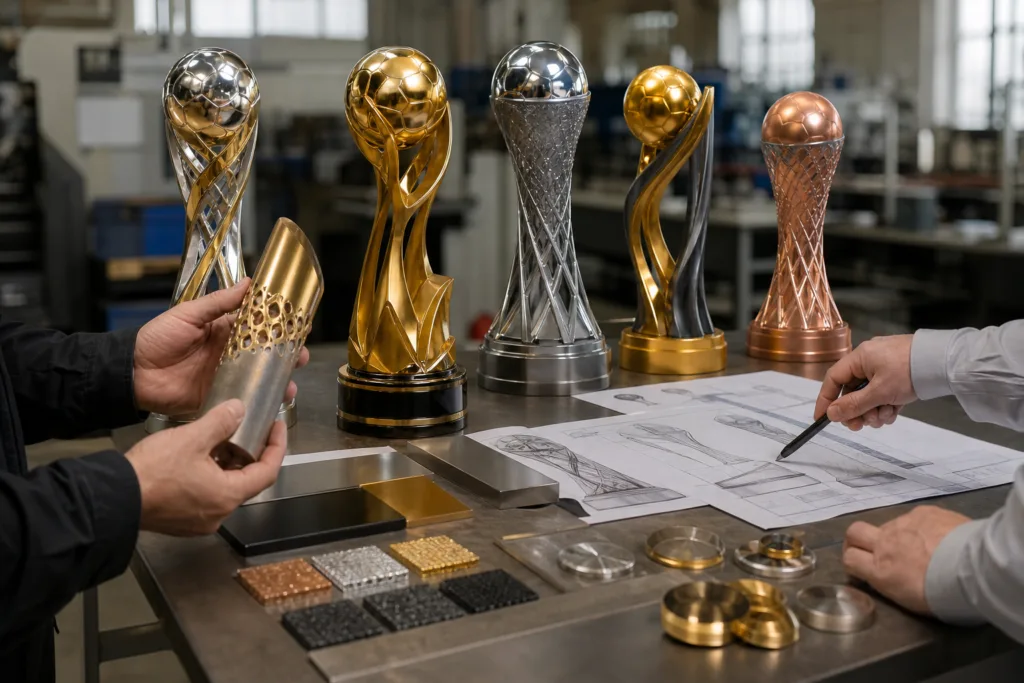
Material and finish should be specified together, not separately. In trophy manufacturing, common routes may include zinc alloy or copper-based decorative components, die-cast metal parts, machined or fabricated elements, and plated or painted surface systems. The final suitability of any route depends on geometry, environment, handling, and supplier confirmation. A visually attractive metal body can still fail early if the finish system is not compatible with the substrate, edge profile, assembly process, or expected contact conditions.
A weather resistant trophy depends on substrate preparation, coating or plating sequence, sealing, edge coverage, and scratch risk. That is why procurement teams should avoid assuming that any metallic-looking finish is equally suitable for outdoor event exposure. Some finishes are primarily decorative and intended for indoor display. Others may be better suited to temporary outdoor use if the construction, pretreatment, and protective layers are aligned with the environment. AMPP notes that protective coatings function as part of a broader corrosion-control approach rather than as decoration alone, which is directly relevant when specifying an outdoor award finish for exposure rather than showroom appearance. See https://www.ampp.org/technical-research/what-is-corrosion/protective-coatings-for-corrosion-control.
Buyers should ask not only what the visible color is, but how that appearance is built. Is the part electroplated, painted, powder coated, clear coated, or combined? How are recessed areas treated? Are sharp edges likely to receive thinner coverage? If the item is scratched during transport, does the damage remain cosmetic, or can it expose a more corrosion-sensitive layer beneath? What maintenance is recommended after rain or handling?
Practical specification questions include:
- Which base metal is proposed, and why is it appropriate for this environment?
- Is the finish system decorative, protective, or a combination of both?
- What pretreatment or substrate preparation is used before coating or plating?
- How are corners, edges, and recessed details managed to reduce weak spots?
- Is a clear top layer or sealant part of the approved construction?
- What should the organizer do if fingerprints, water spots, or minor scratches occur?
When reviewing options, buyers may find it useful to compare general trophy materials and finishes and then narrow the list to those suitable for the actual event environment. If the project is considering metallic visual effects, Me Trophy can also coordinate project-specific review of electroplating finishes with the chosen substrate and assembly design.
A key caution: avoid absolute words such as “rustproof,” “weatherproof,” or “outdoor safe” unless the supplier defines scope and provides relevant evidence. A plated zinc alloy figure on an indoor-style base may not perform like a fully reviewed outdoor-use system. Me Trophy can support material-finish coordination and sample development, but exact durability claims, corrosion expectations, and maintenance limits must be confirmed for each project.
Design Joints, Drainage, and Contact Points
Outdoor durability often fails at assembly details rather than at the main visible surface. Procurement teams understandably focus on color, logo fidelity, and shape, but moisture usually enters through concealed joints, stacked parts, threaded connections, hidden cavities, and damaged edges created during assembly. A trophy can look robust from the front while trapping water behind an emblem, under a plate, or inside a hollow casting.
Buyers should review whether the design includes hollow sections, attached figures, raised medallions, nameplates, rods, or inserts that could create moisture traps. Water that cannot drain or dry efficiently may increase the risk of staining, finish lifting, concealed corrosion, or swelling of nearby non-metal materials. This is especially important for a sports trophy corrosion resistance discussion, because corrosion problems often begin where the eye does not immediately see them.
Multi-material interfaces deserve special attention. If dissimilar metals contact each other in wet conditions, galvanic effects may become part of the risk profile. If an adhesive joint is used, buyers should ask whether the adhesive is appropriate for temperature swings and intermittent moisture, and whether assembly operations could scratch surrounding plated or painted surfaces. Sealed seams may help in some designs, while in others a deliberate drainage path is more practical than trying to create a completely sealed cavity.
Ask these questions during design review:
- Where can water collect if the trophy is exposed to rain or condensation?
- Are there concealed joints, threaded inserts, or hollow chambers?
- What materials are used for screws, rods, washers, and internal supports?
- Are pads, spacers, or isolators needed where metal parts contact each other or the base?
- Can the assembly sequence be adjusted to reduce finish damage during production?
- Will badges, nameplates, or decorative overlays create edge-lift risk after repeated handling?
This is an area where manufacturing coordination matters. Me Trophy’s role as a project partner can include mold development, die casting review, finishing sequence planning, and assembly assessment so the visual design remains manufacturable under the intended exposure conditions. The best outdoor award solution is often not the one with the most pieces, but the one with the fewest avoidable moisture traps and the most controlled contact points.
Select a Stable Base for Outdoor Presentation
The base is both a visual and structural decision. A base that works well on an indoor shelf may not be appropriate for grass, temporary stage decks, damp banquet tables, or windy podium setups. For an outdoor championship award, buyers should think about weight distribution, center of gravity, footprint, anti-slip behavior, edge protection, and moisture interaction between the bottom surface and the ground or table.
Base material selection should be tied to event conditions. Metal bases, engineered composite concepts, and some stone-like or resin-style presentations may all be considered depending on branding and environment, but exact suitability must be confirmed against the use case. Questions include whether the base may swell, stain, chip, tip, or transfer moisture into concealed hardware. Engraved or printed plates also need protection if exposed to rain, wiping, or repetitive handling.
For outdoor presentations, practical concerns often include:
- Will the base sit on fabric, wood stage, grass, concrete, or a wet table?
- How much lifting and passing between presenters is expected?
- Does the trophy need a wider footprint to reduce tipping risk during photography?
- Should the underside include pads, seals, or protective layers?
- Could wet contact between hardware and the base create staining or corrosion at attachment points?
- How will engraved or printed plates be protected from scratching and moisture?
Even if the upper trophy body is well specified, a weak base decision can undermine the project through instability, damaged flooring, chipped corners, or visible wear after only a few events. That is why base review should include the actual presentation surface, not just the trophy dimensions. Buyers planning a custom structure can explore custom trophy bases as part of a complete assembly rather than treating the base as an afterthought.
Me Trophy can develop custom bases and integrated support structures, but the final recommendation should follow application review, artwork, handling method, and packaging plan. Project-specific weight, dimensions, and stability expectations require confirmation.
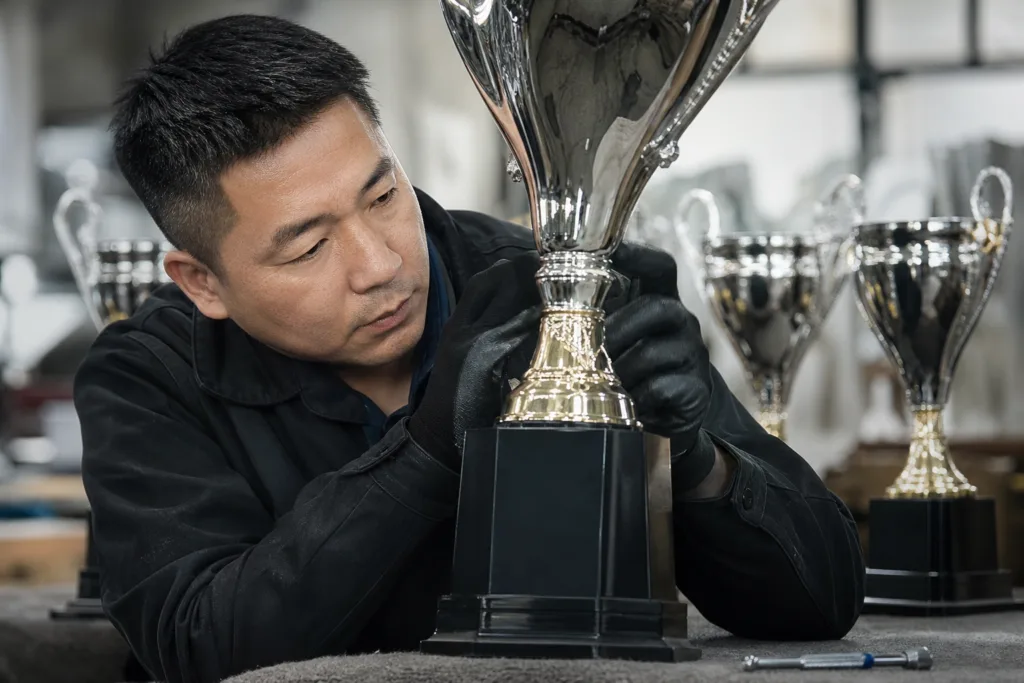
Plan Cleaning, Handling, and Protective Storage
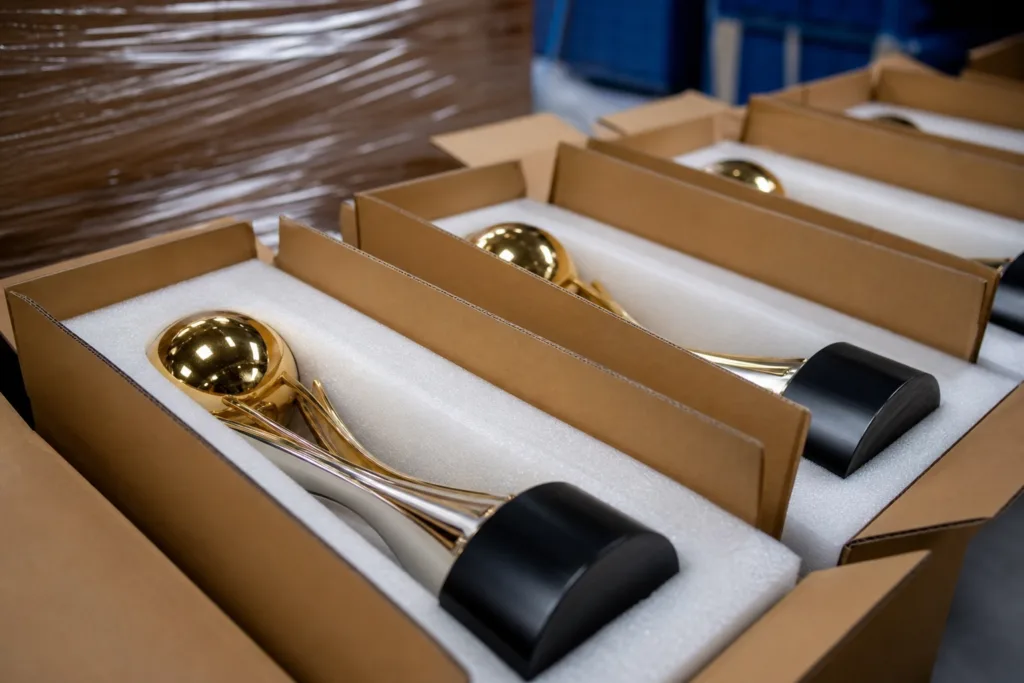
Even a well-specified outdoor sports trophy can lose appearance quickly if cleaning and storage are not planned in advance. Different finishes respond differently to fingerprints, rain spots, airborne dust, and abrasion from repeated packing and unpacking. The procurement scope should therefore extend beyond manufacturing into post-event care instructions and packaging requirements.
A practical plan should define approved cloth types, acceptable cleaning solutions, drying steps after wet exposure, inspection points, and storage packaging. Abrasive wipes, harsh chemicals, and rough cartons can damage plated or painted surfaces faster than the outdoor ceremony itself. Organizers should know whether the trophy must be dried immediately, whether pooled water around joints needs special attention, and whether individual bags, foam inserts, separators, or cartons are required to prevent rubbing in transit.
Useful buyer questions include:
- What cleaning method is approved for the selected finish?
- Should the trophy be dried immediately after outdoor use?
- Are microfiber cloths, neutral cleaners, or water-only wiping preferred?
- What individual bag, foam, tray, or carton format is recommended for storage and export?
- Should corners, joints, and base edges be inspected before repacking?
- Are replacement plates or touch-up options available, subject to confirmed project terms?
Responsibility should also be assigned. In many events, organizers, sponsors, venue staff, and media teams all handle awards. If no one is clearly responsible for post-event drying and repacking, cosmetic issues can appear long before the next season. Packaging is part of the protective system, not just a shipping formality. Me Trophy can support export-ready packaging and handling recommendations, but all maintenance instructions should be finish-specific and confirmed against the final approved construction.
Confirm Testing and Warranty Expectations With the Supplier
Procurement teams should separate marketing language from measurable evidence. The right supplier discussion is not “Is this outdoor?” but “What claim matters for this project, what evidence supports it, and what are the limits of that evidence?” Depending on the use case, the most important claim may relate to appearance retention, corrosion delay, coating adhesion, base stability, or transport durability.
Ask for clarity on sample approval, finish approval standards, relevant test references, exposure assumptions, and any exclusions. If a supplier refers to salt spray or adhesion testing, buyers should ask what exactly was tested, whether the tested sample reflects final mass-production construction, and what the result can reasonably indicate. ASTM B117 is commonly referenced for salt spray exposure practice, but it does not by itself guarantee real-world service life in every environment. See https://store.astm.org/standards/b117.
Practical questions for supplier review:
- Which performance claim matters most for our event use case?
- What laboratory or in-house tests have been conducted on this finish system?
- Does the tested sample represent final substrate, coating stack, assembly method, and hardware?
- What environmental assumptions were used when discussing outdoor suitability?
- What conditions would void any finish expectation or require extra maintenance?
- Are warranty terms offered, and if so, what is included or excluded? Direct confirmation is required.
It is also important to align testing with production control. A strong sample is not enough if mass production does not maintain the same preparation, finish thickness, assembly care, and inspection discipline. Buyers should therefore ask how the supplier’s quality control process supports consistency between approved sample and shipped goods.
Near the commercial decision stage, it is useful to return to the broader category of custom sports trophies and convert environmental needs into a detailed RFQ: exposure type, venue conditions, handling frequency, finish expectations, base requirements, packaging, and evidence requested. Me Trophy can align sampling, finish review, assembly checks, and QC planning with that specification, while all project-specific test evidence, lead times, certifications, MOQs, and warranty terms must be confirmed directly.
Conclusion
Choosing an outdoor sports trophy is a specification exercise, not just a styling decision. The practical sequence is straightforward: define exposure and storage conditions, select the material-finish system together, improve joints and drainage, stabilize the base for the presentation surface, plan cleaning and storage, and confirm evidence with the supplier before approval.
For sports organizations, sponsors, and procurement teams, that approach reduces avoidable risk. It helps distinguish a trophy intended for a short outdoor ceremony from one expected to survive repeated event use or limited outdoor display. Me Trophy can support this work as a manufacturing partner through design review, mold development, die casting, finishing, assembly, packaging, OEM/ODM support, and export coordination. Project-specific outdoor performance, testing scope, and warranty terms require confirmation.
If you are preparing an RFQ, a practical next step is to build an exposure questionnaire and simple risk matrix covering venue, duration, handling, transport, and storage. That information makes supplier evaluation more accurate and sample approval more meaningful.
Frequently Asked Questions
1. What is the first question to ask when specifying an outdoor sports trophy?
The first question is how long and how often the trophy will be exposed outdoors. A short ceremony, seasonal reuse, and extended outdoor display are different conditions and may require different materials, finishes, joints, and base designs.
2. Can any metal-looking finish be used as an outdoor award finish?
No. A metallic appearance alone does not confirm outdoor suitability. Buyers should ask what substrate, pretreatment, finish stack, and test evidence support the proposed use environment, and whether the finish is mainly decorative or intended for outdoor event exposure.
3. Why do joints and hidden hardware matter for sports trophy corrosion resistance?
Many outdoor failures begin at concealed joints, threaded areas, stacked parts, or water-trapping cavities rather than on the main visible face. Joint design, drainage, hardware material, and assembly care can strongly affect cosmetic life and corrosion risk.
4. What should buyers check when selecting a base for outdoor presentation?
Check the presentation surface, tipping risk, footprint, weight distribution, anti-slip needs, moisture exposure, and how engraved or printed plates will be protected. A base suitable for indoor shelving may not be stable enough for grass, damp tables, or temporary stages.
5. What testing questions should buyers ask for a weather resistant trophy project?
Ask what claim is being made, what test method or internal procedure supports it, whether the tested sample matches final production construction, what exposure assumptions apply, and whether any warranty or finish expectation requires direct project confirmation.