
A strong traveling championship trophy design should be planned as a long-term award system, not simply as a one-time presentation piece. For leagues, associations, clubs, and event organizers, the trophy must survive recurring ceremonies, annual winner updates, transport between custodians, storage in changing environments, and repeated handovers without losing its visual authority. That is why many buyers begin with a lifecycle discussion before they finalize styling details. When evaluating custom championship trophies, it is practical to treat the trophy, base, nameplate strategy, case, documentation, and annual maintenance workflow as one connected program.
A well-planned perpetual trophy design supports continuity. It helps committees avoid common problems such as unstable structures, insufficient nameplate space, inconsistent annual engraving, damage during transport, or confusion about who is responsible for return and inspection. The goal is straightforward: create a reusable championship trophy that remains presentable, functional, and easy to manage over many seasons.
This guide is written for B2B decision-makers who need a realistic framework for planning. It focuses on annual ceremony flow, custody management, durability, base engineering, winner capacity, maintainable finishes, case coordination, and future refurbishment. Project-specific points such as final materials, production methods, packaging specifications, lead times, and feasibility for a given design should be confirmed directly with Me Trophy during the quotation and development process.
Define the Trophy’s Annual Ceremony and Custody Cycle
Before approving drawings, define exactly how the trophy moves through each season. A traveling trophy can look impressive at the ceremony but become difficult to manage if the yearly cycle has not been mapped in advance. Procurement teams should document the full route from presentation to next-year preparation.
Map the annual journey
Most long-running programs include these steps:
- Presentation at the championship event or annual gala
- Possession by the winner, host institution, or organizer
- Display period in an office, clubhouse, museum cabinet, training center, or venue
- Return by a fixed deadline before the next event
- Condition inspection for scratches, dents, loose parts, or missing nameplates
- Annual engraving or plate replacement
- Cleaning and minor refurbishment if needed
- Repackaging and logistics preparation for the next ceremony
Each step has design implications. A trophy displayed publicly may need stronger stability and easier cleaning access. A trophy returned through courier channels may need more protective packaging than one hand-carried by staff. A trophy that stays with winners for many months may require clearer custody documentation and a more durable case.
Ask the practical planning questions early
- Who holds the trophy between seasons?
- Does it travel domestically or internationally?
- Will it be hand-carried, courier-shipped, or checked as event equipment?
- Where is it displayed when not in ceremony use?
- Who checks condition before handover?
- Who approves engraving content each year?
- What is the return deadline before the next championship?
- What happens if plates are damaged or a component is lost?
A useful approach is to build a one-page lifecycle timeline showing each annual touchpoint, target date, and responsible party. This document helps design discussions stay grounded in actual operational needs. It also prevents late-stage surprises, such as discovering that the trophy must fit a museum cabinet height limit or that annual return happens through international shipping.
Custody rules, return deadlines, and update procedures should be written before final design approval. Doing this early helps align decision-makers on whether the trophy is mainly ceremonial, mainly archival, or a true traveling asset used heavily across multiple sites.
Design for Handling, Transport, and Display Stability
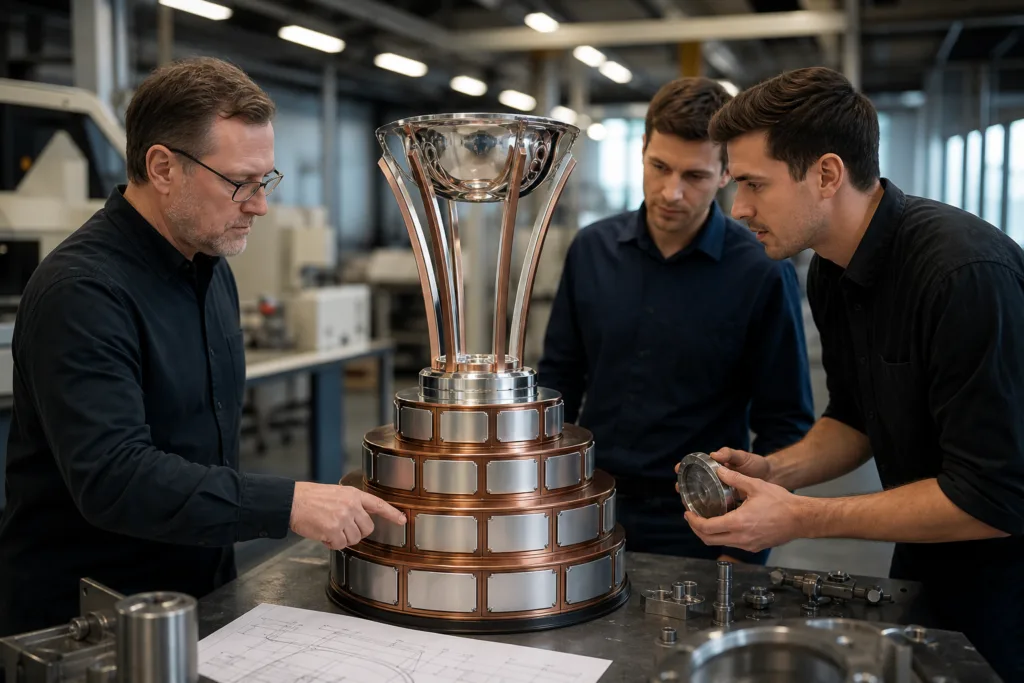
Repeated use creates different design priorities from a one-off award. A reusable championship trophy should be evaluated for handling, transport risk, and display stability from the beginning, not after styling has been approved.
Key structural decisions
The most important design factors include proportion, center of gravity, base footprint, attachment security, and the vulnerability of decorative elements. Tall trophies may look prestigious on stage, but if the upper body is visually heavy and the base is too small, the piece can become unstable during handover, display, or transit. Likewise, thin projections, openwork details, raised figurative parts, or sharp decorative edges may snag foam, deform under pressure, or become high-risk impact points.
Committees should review the approved size, shape, and structure with practical usage in mind. Ask not only how the trophy will look under stage lighting, but how it will be lifted, boxed, unboxed, carried to a podium, stored in a cabinet, and repacked by staff who may not be trophy specialists.
Why robust construction matters
For recurring use, buyers often prefer robust metal construction and engineered assemblies because these can better support repeated handling than fragile decorative approaches. Zinc alloy, copper, or other metal-based configurations may be considered depending on the approved design, finish requirements, and event environment, but final material and structure choices must be confirmed for the specific project with Me Trophy. The correct construction depends on factors such as size, weight distribution, decorative complexity, and how often the trophy will travel.
The base is especially important. It influences stability during display, provides structural support for the main body, and determines future winner-name capacity. Organizers comparing custom trophy bases should evaluate not only aesthetics, but also plate layout, fastener access, cleaning reach, and the possibility of future expansion.
Transport planning should affect the design
Handling risk is often underestimated. Buyers should define whether the trophy will be:
- Hand-carried by event staff
- Transported in a dedicated vehicle
- Sent by courier
- Checked with event equipment
- Moved internationally through export logistics
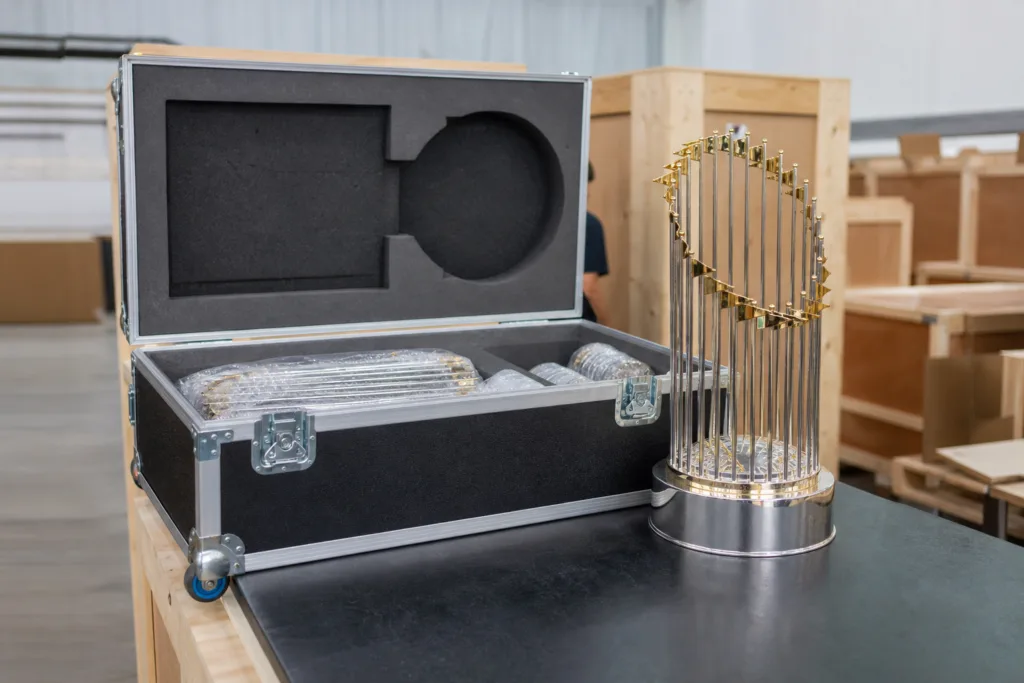
These scenarios change packaging requirements and may even influence the trophy structure itself. A highly protruding crown, handle, or figure can be acceptable for local ceremonial use but problematic for frequent air or courier movement. This is why a dedicated traveling trophy case should be treated as part of the system, not an afterthought.
Packaging fit, internal cushioning, component immobilization, and outer-case handling convenience should be discussed alongside the trophy design. For shipment planning and recurring logistics coordination, buyers may also review Me Trophy’s approach to packaging and export delivery. Exact case materials, internal supports, and protection specifications should be confirmed for the project.
Plan Replaceable Nameplates and Winner Capacity
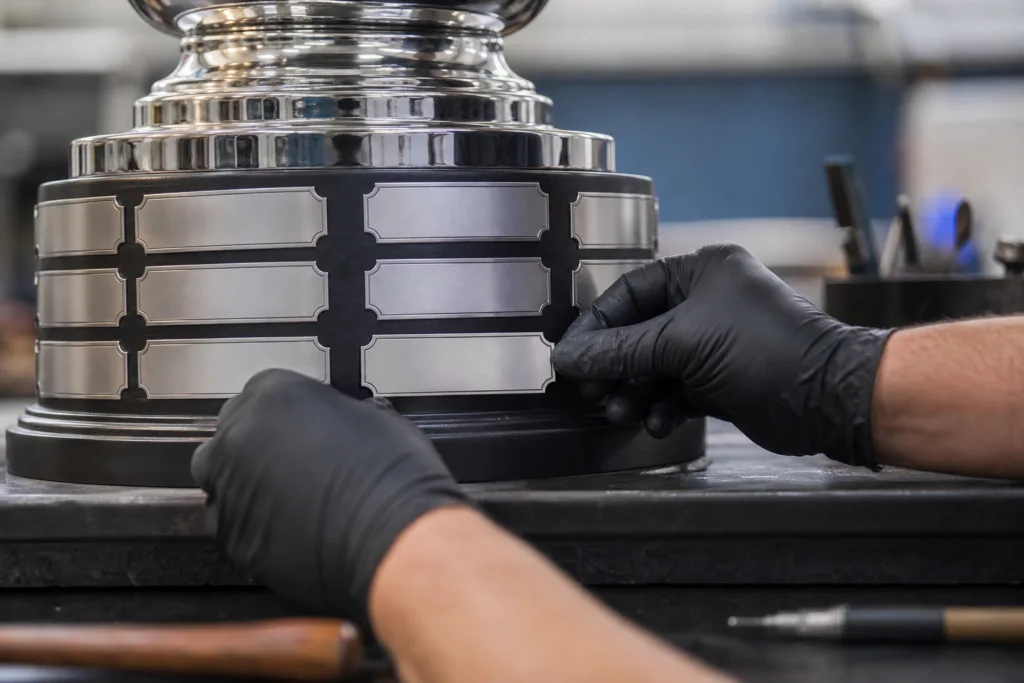
One of the most important decisions in annual winner nameplate trophy planning is whether the winner information is engraved directly onto the main trophy or placed on replaceable plates. For long-running competitions, replaceable nameplates usually provide better maintenance flexibility and easier future updates.
Integrated engraving versus replaceable plates
Integrated engraving areas can look clean, but they may limit future capacity and make updates more difficult if the engraved zone becomes full or hard to access. Replaceable annual winner nameplates support a more manageable workflow. If a plate is damaged, formatting changes, or historical correction is needed, replacing a plate is often easier than altering the entire trophy body.
For annual programs, buyers should define a target planning horizon before finalizing dimensions. The key procurement question is simple: How many future winners must fit? Some organizations plan for 10 years, others for 25 years or more. There is no universal answer, but deciding the horizon early helps avoid a base that looks elegant at launch yet runs out of space quickly.
Estimate future capacity realistically
Start with the competition’s history and expected lifespan. Then estimate how many winners, co-winners, divisions, or special inscriptions must be recorded each year. Do not assume only one line per season if the program may later include venue names, sponsor changes, or revised team naming formats.
| Planning item | Questions to answer | Why it matters |
|---|---|---|
| Target planning horizon | 10, 15, 20, or more years? | Sets required plate capacity and base dimensions |
| Entries per year | One winner, multiple divisions, or co-champions? | Affects plate count and engraving area |
| Plate format | Direct engraving, replaceable plate, ring, or plaque? | Determines update workflow and visual consistency |
| Expansion strategy | Add-on ring, secondary base, archive panel, or successor trophy? | Prevents emergency redesign later |
| Replacement interval | Only when full, or proactive refurbishment cycle? | Supports budgeting and continuity planning |
Consider expansion options from the start
Useful capacity strategies include tiered bases, add-on rings, secondary plaques, and planned refurbishment. A trophy may launch with enough visible nameplate area for the first stage of the program, while the underlying structure is engineered so that another section can be added later. This is often better than waiting until space is exhausted and then redesigning under time pressure.
Championship trophy engraving updates should also be treated as an annual maintenance workflow. Buyers should decide:
- Who confirms winner spelling and engraving format?
- Who produces or orders the new plate?
- Where is the plate attached?
- Are spare blank plates stored in advance?
- How is finish and typography consistency maintained over time?
For buyers considering how annual updates will be managed, Me Trophy’s engraving and assembly capabilities can be part of the discussion, but exact update procedures, spare part planning, and yearly support arrangements require project confirmation.
Branding should also be considered carefully. If identity marks or event branding appear on plates or the main body, define whether these are fixed for the life of the award or likely to change. Me Trophy’s logo engraving options may be relevant during planning, especially when balancing permanent identity elements with annual update zones.
Choose Maintainable Finishes and Cleanable Surfaces
A trophy used year after year must remain presentable under real handling conditions. Buyers often focus on visual impact at the launch ceremony, but finish maintenance is just as important for long-term satisfaction.
Evaluate finishes from a service perspective
Different finishes vary in how visibly they show fingerprints, micro-abrasion, dust, and handling wear. Highly reflective surfaces can look impressive, but they may reveal smudges quickly in public display settings. Deep textures may mask fingerprints yet create more cleaning difficulty around edges or recesses. Painted areas, plated surfaces, polished metal zones, and mixed-finish designs should be reviewed not only for appearance but for ongoing upkeep expectations.
Buyers should balance prestige appearance with realistic maintenance. If the trophy will be displayed in open environments and frequently touched during handovers, a finish system that is easier to clean consistently may be more practical than one that requires specialist care to stay immaculate.
Cleaning and plate-replacement access checklist
- Can staff reach around decorative details without stressing fragile parts?
- Are plate fasteners or fixing points accessible during annual updates?
- Do recesses collect dust that is difficult to remove?
- Will fingerprints show strongly on the most visible presentation surfaces?
- Are there exposed corners or ridges that may lose visual sharpness from repeated handling?
- Can the base be cleaned without removing the main body?
- Does the finish around nameplates remain consistent after repeated replacements?
Exact finish recommendations, plating systems, coating choices, and maintenance instructions should be confirmed with Me Trophy according to the approved design, expected usage conditions, and storage environment. This is particularly important when the trophy may encounter different climates, varied display locations, or repeated logistics handling over many years.
Create Cases, Instructions, and Handover Records
A successful traveling trophy program includes more than the trophy itself. It should also include the documentation and accessories that make annual movement controlled and repeatable.
What to include in the system
- Protective travel case
- Packing layout guide
- Handling instructions
- Return checklist
- Condition log
- Handover form for each transfer
An effective traveling trophy case should consider fit, cushioning, hardware protection, clear orientation, label areas, and storage convenience. If the trophy includes exposed handles, figurative elements, or layered base levels, the internal structure of the case becomes especially important. Case construction details, materials, and internal support design must be confirmed for the project.
Each recipient should receive a simple custody packet explaining how to open the case, lift the trophy safely, inspect it before transfer, and meet return deadlines. This helps reduce preventable handling damage and clarifies responsibility when the trophy changes hands.
Assign annual responsibilities by name
Another key procurement question is: Who updates and inspects the trophy each year? The answer should not be informal. Assign named roles for engraving coordination, condition review, custody approval, and logistics management. Even if one department oversees the full program, documenting accountability reduces delay and confusion.
A practical handover record may include:
- Date of transfer
- Outgoing custodian
- Incoming custodian
- Condition notes
- Missing or damaged items
- Return due date
- Approved engraving text for the current season
Near the point of final specification, buyers often revisit the overall requirements with Me Trophy through the custom championship trophies page to align structure, base engineering, update access, and case planning before sample development. As a manufacturing partner, Me Trophy can support planning discussions around durable structure, base coordination, and recurring-use readiness, while project-specific feasibility and supply details require confirmation.
Plan Expansion or Refurbishment Before Space Runs Out
Many organizations wait too long to decide what happens when winner-name capacity is nearly full. This often leads to rushed redesigns, inconsistent plate additions, or compromised aesthetics. A better approach is to define the future path while the original trophy is still being developed.
Practical long-term paths
- Add a new base section engineered to match the original style
- Replace filled plates and archive them in a companion record display
- Issue a successor trophy while preserving the historical trophy separately
- Refurbish the structure, update surfaces, and continue the same program identity
Each path affects the original design. If add-on sections may be required later, attachment logic and visual proportions should be anticipated early. If plates may eventually be archived, their dimensions and formatting should support organized historical storage. If the trophy might be refurbished, surface access and component separation become more relevant.
Early consultation is valuable because future modification is easier when the design has already considered base development, assembly logic, and possible mold-related constraints. Me Trophy can support custom base development, design coordination related to mold and production planning, and refurbishment discussions as a manufacturing partner. Exact technical solutions, compatibility with existing components, and refurbishment feasibility must be confirmed for the specific project.
Practical FAQs
1. How many years of winners should a perpetual trophy be designed to hold?
There is no fixed number for every competition. Buyers should set a target planning horizon based on program history, expected lifespan, and how much text must be recorded each year. A 10-year layout may suit some events, while others should plan for 20 years or more. The important point is to decide the horizon before dimensions are finalized.
2. Is direct engraving or a replaceable nameplate better for annual updates?
For many recurring award programs, replaceable nameplates are easier to manage. They simplify corrections, support visual consistency, and make future expansion more practical. Direct engraving may suit some designs, but it can limit flexibility if the engraved area becomes full or difficult to access.
3. What should be included in a traveling trophy case?
A good case should be planned around fit, cushioning, orientation, protection for raised or delicate parts, label areas, and ease of storage and transport. The internal layout should help non-specialist staff repack the trophy correctly. Exact case materials and construction should be confirmed with Me Trophy for the project.
4. Who should be responsible for annual engraving updates and inspections?
Assign named roles rather than leaving this informal. One person or department should approve engraving text, another should manage logistics and return timing, and a designated reviewer should inspect condition before each handover or ceremony. Clear accountability improves schedule control and reduces errors.
5. What should organizers do when the trophy runs out of nameplate space?
The best time to decide is before production. Common options include adding a new base section, using secondary plaques, archiving filled plates, refurbishing the existing structure, or launching a successor trophy while preserving historical records. Early planning avoids emergency redesign and keeps the award program visually consistent.
Conclusion
A durable traveling championship trophy design is really a lifecycle system. It must balance ceremony impact with serviceability over years of custody changes, transport, annual winner updates, cleaning, inspection, and possible refurbishment. For procurement teams, the most effective planning tools are a lifecycle timeline and a winner-capacity table prepared before final drawings or samples are requested.
By defining the annual cycle, confirming transport conditions, planning replaceable plates, selecting maintainable finishes, and coordinating the case and handover process, buyers can reduce avoidable cost and confusion later. For organizations developing a perpetual trophy design or annual winner nameplate trophy program, Me Trophy can support structured design discussions as a manufacturing partner focused on custom development, base engineering, update readiness, and long-term planning. Project-specific production details, materials, timelines, and refurbishment options should be confirmed directly during the project review.