
A well-written custom trophy design brief does more than describe a creative idea. It gives a manufacturer the information needed to judge feasibility, interpret brand intent, reduce avoidable revisions, and plan the right path for sampling, mold development, casting, finishing, assembly, packaging, and export delivery. For international B2B buyers, that clarity is especially important when marketing teams, event organizers, procurement, and overseas production partners all need to work from the same document. After your inputs are defined, Me Trophy can review them through its custom trophy design services and discuss the project from a manufacturer perspective.
This article is built for scenario-solving, not inspiration browsing. If you are turning an award concept into an OEM or ODM project, the brief must connect story, branding, ceremony needs, technical constraints, quantity planning, budget position, and approval workflow. A strong brief helps your manufacturer tell you what is practical, what needs adjustment, and what can be optimized before the sample stage becomes slow and expensive.
Define the Award Story and Recipient Experience
Every custom award starts with purpose. Before discussing metal thickness, base size, or plating color, define what the trophy is meant to recognize and how it should feel in the recipient’s hands. A design team cannot translate emotion into form if the underlying story is vague.
Your brief should state the award name, achievement category, event theme, and prestige level. It should also describe the tone: formal, modern, premium, athletic, commemorative, symbolic, or a combination. This matters because a championship trophy, a corporate leadership award, and a memorial recognition piece may all use metal construction, but they should not communicate the same message.
Buyers should distinguish between non-negotiable narrative elements and open interpretation. For example, a sports federation may require a national symbol and a specific championship year, while the manufacturer is free to propose how those elements are balanced into the silhouette. A corporate client may insist that innovation and sustainability are reflected in the award, but leave the structural language to the design team.
Include any historical motifs, sport-specific cues, or corporate values that must appear. If there are references from prior award editions, explain whether the new design should evolve them or break from them. That helps avoid a common problem: the manufacturer creates a polished concept that is visually strong but strategically wrong for the event’s heritage or stakeholder expectations.
A useful practical output is a three-to-five-line trophy concept statement. Keep it simple:
- Award purpose: What achievement is being recognized?
- Audience message: What should recipients and viewers remember?
- Design tone: Premium, dynamic, ceremonial, modern, etc.
- Required symbolism: Sport icon, brand value, anniversary motif, national cue, or founder reference.
If your team needs a planning framework before drafting the full document, start by outlining the trophy project brief internally so story and commercial requirements stay aligned.
Describe Audience, Event, and Presentation Context

Manufacturers do better work when they know where the trophy will be seen and how it will be used. A piece designed for a televised stage reveal may need different proportions than one intended for office display, school recognition, or distribution to regional event winners.
Your custom award design requirements should cover the presentation context in practical terms:
- Recipient profile: executives, athletes, students, dealer partners, employees, or VIP guests
- Age group: important if handheld safety, size perception, or durability needs differ
- Event scale: local ceremony, national championship, multinational sales program, gala dinner, or internal corporate recognition
- Venue type: stadium, ballroom, auditorium, office event, hotel banquet, or outdoor setting
- Lighting and camera visibility: stage spotlights, broadcast conditions, photography-heavy environment, or display cabinet usage
- Presentation method: handed over on stage, couriered to remote winners, placed at tables, or used as a photo-op centerpiece
- Post-event destination: shelf display, cabinet, office desk, team clubhouse, museum-like display, or repeat ceremonial use
For international buyers, include destination market, language requirements for nameplates or engravings, and any local customs, sponsor expectations, or protocol issues that influence how symbols and text should appear. If the product will cross borders, note documentation responsibilities early. The U.S. International Trade Administration offers a useful overview of export documentation requirements for international trophy shipments, which can help teams think through consignee information, packing lists, and commercial paperwork needs.
Also identify presentation risks. For example, a high center of gravity may make a trophy unstable on a narrow table. Long protrusions may look dramatic in renderings but raise handling and transit concerns. Mirror-bright finishes can create glare under stage lights. Final suitability should be confirmed with the manufacturer for the project, but these risks should be disclosed in the brief so they are engineered, not discovered late.
Set Required Branding and Symbolic Elements
One of the most common causes of trophy redesign is poor hierarchy in branding inputs. Buyers send multiple logos, slogans, mascots, and sponsor marks without clarifying what must appear and what is optional. The result is visual crowding, repeated layout changes, and tooling decisions made before the branding stack is stable.
A strong award design questionnaire separates branding into two groups:
- Must-have elements: required logo, event title, year, governing body emblem, sponsor mark, mandatory legal text, or national symbol
- Preferred elements: tagline, secondary sponsor, mascot, commemorative graphic, pattern, texture reference, or supporting iconography
Provide source files and define placement priorities. Say whether a logo must appear on the front face, base plate, side panel, top icon, packaging insert, or certificate card. If multiple marks are required, rank them in order. This gives the manufacturer room to protect visual balance while still honoring brand obligations.
It is also useful to specify how branding might be expressed. Depending on the design and production method, logos or emblems may be created through relief detail, engraving, die-cast sculpting, printed inserts, electroplated elements, painted zones, or attached components. The most suitable process should be confirmed by the manufacturer based on actual geometry, finish, quantity, and assembly method.
Before submitting your brief, use this mini checklist:
- Approved logo versions are attached
- Color references are provided
- Spellings, names, dates, and award titles are verified
- Language review is complete for all visible text
- IP authorization exists for all supplied artwork and symbols
If your artwork package is incomplete, pause the project rather than forcing concept work with temporary files. For a deeper review process, Me Trophy can provide design evaluation before sampling so branding feasibility and structure questions are addressed earlier.
Provide Size, Handling, Display, and Packaging Constraints
Design intent has to be translated into physical boundaries early. Many redesign cycles happen because the first concept is approved visually, then later found to be too large for a display case, too heavy for comfortable handover, too unstable for a narrow base, or too vulnerable for export packing.
Your brief should define:
- Approximate height range
- Preferred weight feel
- Handheld comfort expectations
- Base footprint limits
- Shelf, plinth, or display-case restrictions
- Outer carton or courier size concerns
- Need for safe transport to regional events or international destinations
For structure, explain whether the concept points toward custom metal trophies, zinc alloy or copper components, die-cast forms, mixed-material assemblies, or a custom base. Me Trophy can review feasibility across mold development, casting, finishing, assembly, and packaging, but final material selection and build method must be confirmed for the specific project.
It also helps to describe your expectations for size, shape, and structure in functional terms. Do you want a tall hero piece for stage presence, a compact award for easy shipping, or a substantial weight feel to signal prestige? These choices influence engineering and cost path immediately.
Packaging should be defined in the brief, not treated as a last-minute add-on. State whether you need an individual gift box, protective insert, branded box, export master carton, or premium unboxing experience for VIP recipients. If the award includes plated surfaces, sharp edges, multiple parts, or delicate projections, ask the manufacturer to recommend protective adjustments before sample approval. UPS provides practical carrier packaging guidance for fragile presentation products that supports planning for cushioning, carton strength, and transit handling.
When breakage risk, finish scratching, or export complexity is a concern, include that concern explicitly. A manufacturer can often suggest structural changes, separate component packing, or insert upgrades more efficiently before tooling and sample revisions pile up.
State Quantity, Target Timing, and Budget Position
Even when design is still evolving, manufacturers need commercial context. Without it, they cannot recommend an appropriate construction strategy. A one-off VIP trophy, a 50-piece distributor award set, and a recurring annual championship family may all begin with the same drawing but require very different mold, finish, and packaging decisions.
Your trophy concept brief should include:
- Estimated order quantity by variant or SKU
- Number of award categories
- Prototype or pre-production sample needs
- Target event date
- Preferred delivery window
- Whether the program may repeat annually with design updates
Budget should be stated as a position, range, or tier, not as a vague request for something “premium but affordable.” For example, define whether you need one flagship championship piece with lower-tier companion awards, or a family of matching awards with controlled cost differences. This allows the manufacturer to advise where complexity adds value and where it may not.
Quantity and budget affect mold strategy, level of detail, finishing complexity, assembly method, packaging type, and sampling path. Production schedule and pricing require manufacturer confirmation, so do not assume standard lead times or unit economics without review. If files, approvals, or naming data are still pending, mention that in the brief because it affects planning realism.
Procurement teams should also ask a few direct questions:

- Is this a one-off project, a recurring annual program, or a scalable award family?
- Is there enough time for concept review, CAD, sample creation, revision, mass production, and export delivery?
- Which variants genuinely need unique tooling, and which can share structures or bases?
- Will future editions use the same core trophy with changing plates, inserts, or year details?
Where artwork preparation affects timing, align the brief with the manufacturer’s artwork and CAD requirements so design interpretation is not delayed by missing production-ready assets.
Assign Stakeholders, Deliverables, and Approval Gates
Many custom trophy projects slow down not because the trophy is difficult to make, but because no one has defined who owns each decision. The manufacturer may wait for logo approval while the client assumes procurement is waiting for an updated render. The event date keeps approaching, but the workflow remains unclear.
Your trophy project brief should identify the people and decisions that govern the job:
- Internal brand owner: protects identity and story
- Procurement contact: manages supplier communication and commercial alignment
- Event operations lead: confirms venue, presentation, and shipping realities
- Finance reviewer: checks budget compliance
- Final approver: signs off design direction and physical sample
It is equally important to define expected deliverables from both sides. Typically, the buyer provides the brief, branding files, copy text, and decision deadlines. The manufacturer may provide concept interpretation, feasibility feedback, sample planning, finish recommendations, packaging suggestions, and approval checkpoints. Exact deliverables should be confirmed for each project.
The key question is simple: what is non-negotiable, what is open to interpretation, and who has authority to decide? If that is not clear in writing, the sample stage often turns into open-ended ideation rather than controlled validation.
A practical gate structure looks like this:
| Gate | Buyer action | Manufacturer action |
|---|---|---|
| Brief sign-off | Confirm scope, assets, priorities, and approvers | Review feasibility and raise risks |
| Concept direction approval | Select preferred design route | Refine concept for engineering |
| Engineering or sample approval | Approve structure, branding placement, and finish intent | Prepare sample path and recommendations |
| Pre-production confirmation | Verify final text, packaging, and quantities | Align production execution details |
| Shipment release approval | Approve delivery documentation and dispatch readiness | Arrange packing and shipment process |
Build a One-Page Trophy Design Brief Template
A practical trophy design brief template should fit on one page plus attachments. The goal is not to write a long narrative. The goal is to create a manufacturer-ready summary that can be reviewed quickly by design, engineering, procurement, and operations teams.
Use the following structure:
- Project name
- Event and date
- Award purpose
- Recipient profile
- Story or theme
- Mandatory branding
- Preferred symbolism
- Size target
- Handling and display constraints
- Packaging needs
- Quantity by SKU
- Budget position
- Timing milestones
- Destination market
- Stakeholder list
- Approval owner
- Attached assets
The recommended asset set is simple: a one-page design brief template and a stakeholder checklist. Use it as an award design questionnaire before contacting a manufacturer so the first conversation is focused and commercially useful. If you already have a draft, you can submit your brief to Me Trophy for project review and next-step discussion.
Common Mistakes That Cause Trophy Redesigns and Delays
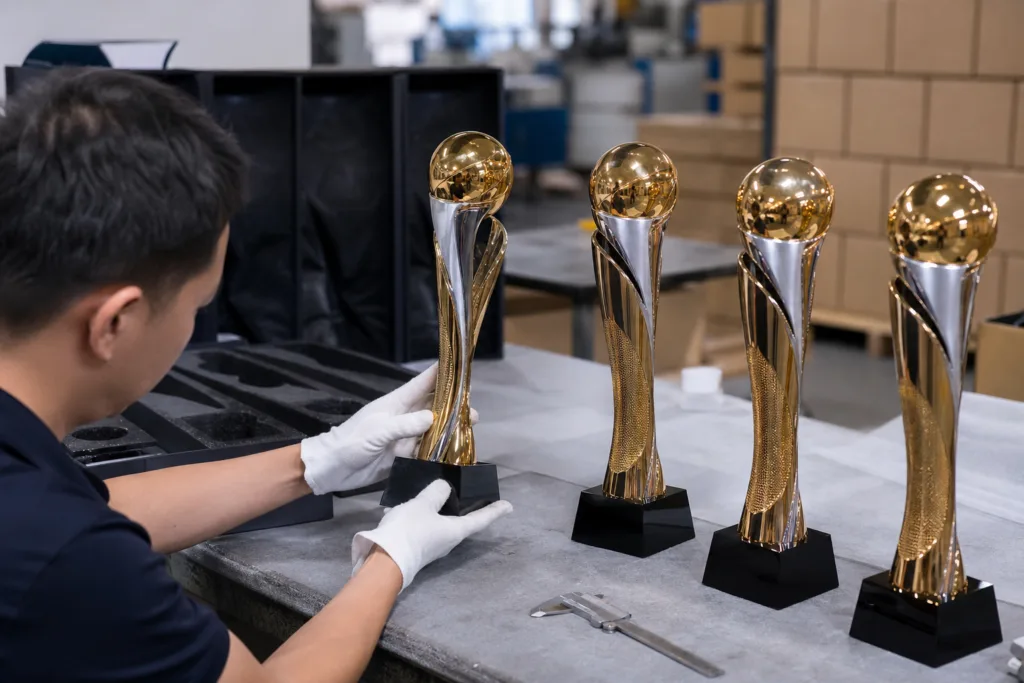
Most redesign problems are preventable if the brief is disciplined. Here are common failures and the corrective actions buyers can take before submission.
Unclear hierarchy of branding elements
Problem: Too many mandatory marks compete for the same visual space.
Fix: Rank all branding by must-have versus preferred, and define placement priorities.
No approved artwork
Problem: Temporary logos or low-resolution files trigger repeated revisions.
Fix: Do not start production interpretation until approved source files and text are locked. Adobe provides official artwork file setup guidance for print-ready assets that can help marketing teams prepare usable inputs.
Unrealistic physical size expectations
Problem: The desired look does not match handling, stability, or shipping realities.
Fix: State the acceptable height, weight feel, base footprint, and display limitations in the brief.
Missing packaging requirements
Problem: Packaging is considered only after the trophy is finalized, causing avoidable redesign or extra protection costs.
Fix: Define gift box, insert, export carton, and transit expectations from the start.
No final approver
Problem: Multiple stakeholders comment, but no one closes decisions.
Fix: Name one person with final authority for design direction and sample approval.
Treating the sample stage as open-ended ideation
Problem: Teams continue changing concept strategy after engineering has begun.
Fix: Lock the brief and concept direction first, then use the sample stage to validate execution, not restart creative exploration.
Conclusion
A strong custom trophy design brief aligns creativity with manufacturing reality. When buyers define the award story, event context, branding priorities, physical constraints, packaging needs, quantity, budget position, and approval flow upfront, manufacturers can respond with more relevant proposals and smoother execution. That reduces misunderstanding, shortens revision loops, and improves the handoff from concept to sampling and production.
If your team has completed a brief or needs help turning internal ideas into manufacturer-ready inputs, Me Trophy can review the project through its custom trophy design services and discuss feasibility, sampling direction, and production planning.
Related Reading
- custom trophy RFQ guide
- design choices and manufacturability
- trophy base sizing guide
- bulk order checklist
- FAQ
FAQs
What is the most important part of a custom trophy design brief?
The most important part is clarity on purpose and constraints. A manufacturer needs to understand what the award represents, which branding and symbolic elements are mandatory, how the trophy will be presented, and what physical, packaging, quantity, timing, and approval limits apply.
How detailed should a trophy design brief template be?
It should be concise but complete. A one-page summary with attachments is usually the best format for B2B projects. The brief should cover story, audience, branding, size, handling, packaging, quantity, budget position, milestones, destination, and approval ownership without becoming an unstructured creative document.
Should I include budget in a trophy project brief?
Yes. You do not need to state a fixed number if internal approval is still developing, but you should indicate a realistic range or tier. Budget position helps the manufacturer recommend suitable construction, finishing, tooling strategy, and packaging options.
What files should I send with an award design questionnaire?
Send approved logo files, text copy, event details, reference visuals if relevant, and any existing brand guidelines. If available, include production-friendly vector artwork and clearly named assets. Exact file requirements should be confirmed with the manufacturer for the project.
When should packaging requirements be included in custom award design requirements?
Packaging requirements should be included from the beginning of the brief. If the trophy has delicate finishes, multiple parts, export transit risks, or premium presentation needs, packaging affects structure, materials, assembly, and shipping planning long before mass production.