
For overseas buyers, a custom trophy manufacturer audit is less about brand promises and more about proof. Before you move into RFQ, sampling, or a pilot order, you need evidence that the supplier can produce your award type consistently, document the process, and support export work without avoidable errors. That is especially important for custom metal trophies, zinc alloy and copper trophies, die-cast awards, and projects where finish quality and packaging are part of the product specification. For a broader manufacturing view, start with the custom trophy manufacturer pillar page, then use this checklist to verify fit in detail.
This guide is written for procurement managers, sourcing teams, brands, sports organizations, event agencies, distributors, and product developers. It focuses on award supplier due diligence that can be checked with documents, photos, samples, and direct questions. Where Me Trophy capabilities are mentioned, treat them as areas to confirm directly with the factory, not as assumed facts.
1. Match Factory Capabilities To Your Trophy Specification
Start by matching the supplier to the actual award structure you need. A factory may be strong in simple cast medals but weak in multi-part trophies, mixed materials, or premium base construction. Your first audit should confirm whether the factory can handle the exact combination of material, geometry, finish, and packaging in your brief.
Ask the factory to identify which operations are in-house and which are outsourced. For an integrated manufacturing setup, you want clarity on design support, tooling, casting, finishing, assembly, inspection, and export handling. If any major step is subcontracted, ask how that work is controlled and how defects are prevented from moving downstream.
Evidence to request
- Product photos that match your trophy category, not generic award images.
- Equipment list for casting, polishing, plating, painting, engraving, and assembly.
- Process photos from the current workshop, not edited brochure material.
- Sample references for similar structures, finishes, and base styles.
- A clear process map showing what is done in-house versus externally.
Buyer questions
- Which trophy structures are routine for your factory?
- What materials do you process directly, and what is purchased or outsourced?
- Can you show examples of zinc alloy and copper trophies with similar complexity?
- How do you control fit between the body, inserts, and base?
- What packaging formats have you used for export orders?
For complex base systems or multi-part builds, confirm whether the supplier has a defined mold development process that covers engineering review, trialing, and approval before mass production.
2. Review Design Engineering And Tooling Control

Tooling control is one of the strongest signals of a capable trophy partner. Poorly managed drawings or molds create repeat defects, delayed sampling, and unexpected change costs. A serious overseas trophy supplier verification should show how drawings, 3D files, molds, revisions, and approval samples move through the project.
Ask who reviews the drawing before tooling starts. For custom shapes, logos, embedded parts, and integrated bases, you need evidence that the factory checks wall thickness, demolding risk, assembly tolerance, and finish access before cutting steel or opening a mold. If the supplier cannot explain that workflow clearly, the project risk is already visible.
What to verify
- Ownership of the mold or tooling, including who pays for it and who keeps it.
- Revision control for drawings and sample comments.
- How approval samples are labeled and stored.
- Whether the factory keeps a trail of version history for each project.
- How changes are approved after first sample, including impact on timing and cost.
For a tighter sample strategy, connect this audit to pilot sample production so you can test geometry, finish, and packaging before committing to volume.
Red flags
- Tooling questions are answered only with general sales language.
- Samples arrive without version notes or drawing references.
- Changes are handled verbally with no written record.
- The factory cannot explain how it protects logo sharpness or thin features.
3. Verify Casting, Finishing, And Assembly Workflows
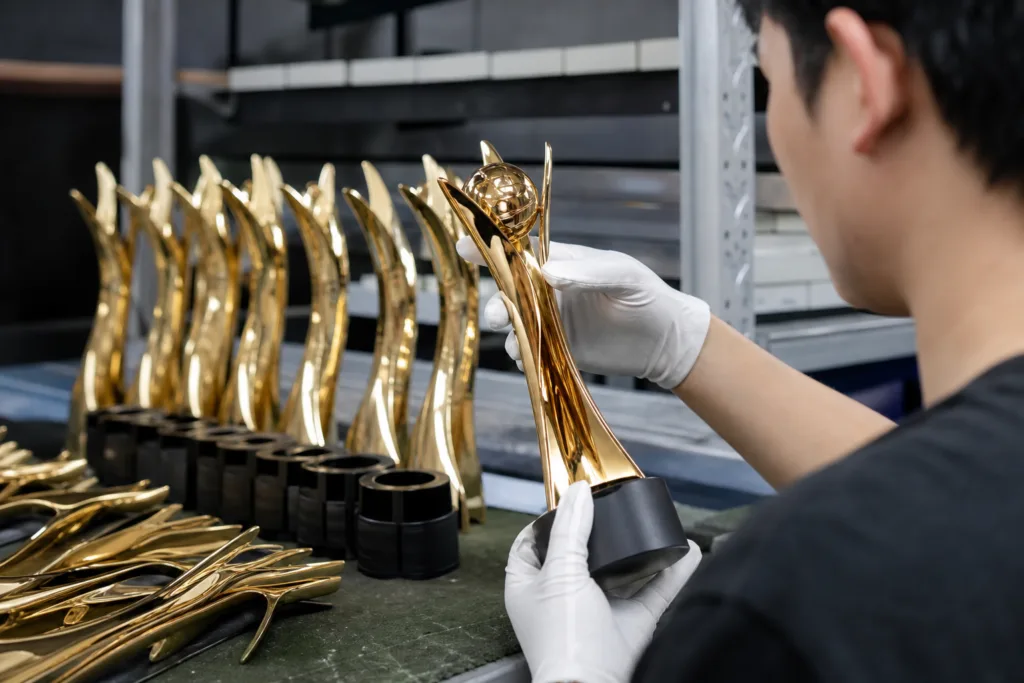
Custom trophy manufacturer capabilities become visible in the process, not the brochure. The core manufacturing steps should be controlled with documented work instructions and in-process inspection points. That matters because small errors in die-casting, polishing, electroplating, painting, engraving, or assembly can compound into visible defects on the finished award.
Ask for a process card or workflow summary for each major operation. If the supplier makes die-cast awards, request proof that die parameters, trimming, grinding, and surface preparation are controlled. If the trophy uses mixed finishes, enamel, or assembled components, ask how the factory prevents contamination, scratches, misalignment, and finish bleed.
Process areas to examine
- Die-casting or casting method used for the body.
- Grinding and polishing stages before plating or paint.
- Electroplating or coating controls for finish consistency.
- Painting, color matching, and drying controls.
- Assembly sequence for bases, inserts, plates, and decorative parts.
- Final touch-up and cosmetic inspection before packing.
For buyers who need to compare process discipline, quality control workflow details are especially useful because they show where checks happen and what the factory records before shipment.
Ask for photo evidence
- Work-in-progress photos at each major step.
- Finished-product photos under neutral lighting.
- Close-ups of plated edges, engraving, and joins.
- Packaging photos showing how the award is protected after assembly.
4. Examine Quality Records And Traceability
A supplier can speak confidently about quality and still lack records that matter during a claim, rework, or repeat order. Your audit should confirm whether the factory keeps inspection standards, defect logs, incoming material checks, batch traceability, and final QC reports. That is the evidence that supports repeatability across multiple runs.
Ask how nonconforming pieces are identified, isolated, and reworked. If a supplier does not have a clear disposition process, the risk is that defective parts are mixed back into production. For international buyers, the practical question is not only whether defects are checked, but whether the factory can prove what was made, when, and under which approval set.
Request these records
- Incoming material inspection criteria.
- In-process inspection sheets.
- Final inspection report for the most recent similar order.
- Batch or job traceability format.
- Nonconformance or rework handling method.
Verification should also cover compliance and certification claims. Any certification, material declaration, or market-specific compliance document relevant to your destination should be confirmed directly for the project. Do not assume a general certificate covers your order or destination market.
5. Assess Packaging, Export, And Communication Readiness
For overseas shipments, packaging is part of product quality. A trophy can leave the factory looking perfect and still arrive damaged if the carton structure, internal protection, palletization, or labeling is weak. Ask the factory to explain how it validates packaging for transport hazards and whether it has considered drop, vibration, or compression risks. The packaging validation and transit-testing best practices for export shipments are a useful reference when you are evaluating whether a supplier thinks beyond the carton itself.
Also check export document control. The supplier should know how to prepare the export documentation the supplier should be able to prepare correctly, including invoice and packing list accuracy, and should be able to coordinate shipment documents against the actual packing configuration. This is a basic due diligence point for overseas buyers because a paperwork mismatch can delay customs clearance even when the goods are ready.
Audit questions for export readiness
- What carton and inner protection structure is used for fragile finishes?
- How are cartons labeled for SKU, quantity, and destination?
- How are pallets or master cartons arranged for export?
- Who prepares shipping documents and who checks them?
- What is the escalation path if a packing or document issue is found before departure?
- Can the supplier support OEM/ODM communication across time zones and languages?
For project owners who need a packaging standard before mass order, confirm whether the factory can explain its packaging and export delivery process in practical terms, including how it protects plated surfaces, sharp edges, inserts, and base finishes.
6. Score Findings And Plan A Pilot Order
A useful factory audit ends with a decision, not a loose impression. Build a scorecard that separates capability fit from communication quality. A supplier may be responsive but weak in tooling control, or technically strong but poor at export coordination. Treat those as distinct risks.
A practical scoring model uses five areas: capability fit, engineering control, quality discipline, export readiness, and communication reliability. Assign pass/fail criteria before the audit, then compare every supplier against the same standard. This makes it easier to shortlist objectively and defend the decision internally.
Suggested decision logic
| Area | What good looks like | Typical fail signal |
|---|---|---|
| Capability fit | Factory has similar award examples and process coverage | Only generic samples or unrelated product references |
| Engineering control | Drawing, mold, and sample revisions are tracked | No version control or unclear tooling ownership |
| Quality discipline | Inspection records and defect handling are documented | Quality claims without records |
| Export readiness | Packing and document control are explained clearly | Packing and paperwork are handled ad hoc |
| Communication | Questions are answered specifically and consistently | Delayed, vague, or contradictory responses |
If the scorecard is strong but the project is high value or technically sensitive, use pilot sample production as the next gate before volume. That gives you a controlled way to verify appearance, fit, finish, and transit resilience before a larger commitment.
7. Factory-Audit Scorecard And Evidence Request List
Use the list below as a buyer-ready audit sheet. It is designed for procurement teams that need a clear record before moving to quotation approval or sample sign-off.
Scorecard items
- Product match to your exact trophy category.
- In-house process coverage versus outsourced work.
- Drawing and mold control discipline.
- Capability for casting, finishing, assembly, and touch-up.
- Quality record strength and traceability.
- Packaging protection and export document handling.
- Responsiveness and cross-time-zone communication.
Evidence request list
- Factory profile and process map.
- Equipment list with key workshop photos.
- Similar product samples or project references.
- Drawing revision history and sample approval trail.
- Process cards for casting, plating, painting, and assembly.
- Inspection records and final QC report sample.
- Packing spec, carton photos, and label format.
- Sample export paperwork template.
When you are reviewing Me Trophy as a possible project partner, the right approach is direct confirmation of the relevant capabilities: design support, tooling, casting, finishing, assembly, QC, packaging, OEM/ODM communication, and export coordination. Ask for evidence in each area rather than assuming coverage from a sales summary.
Practical Summary

A strong trophy factory audit checklist does three things: it proves the supplier can manufacture your award structure, it shows whether the process is controlled, and it tests whether the factory can ship internationally without avoidable friction. That is the standard that matters before RFQ, sampling, or a pilot order.
Use the audit to reduce uncertainty, not to collect slogans. The best custom award factory questions are the ones that force evidence: photos, process records, sample history, and document templates. If a supplier can answer those cleanly, you have something worth shortlisting.
Related Reading
- inspection checklist for bulk orders
- custom trophy RFQ guide
- tooling approval questions
- OEM trophy buying guide
- buyer FAQ
FAQ
What should I ask first in a custom trophy manufacturer audit?
Start with product fit, in-house process coverage, and proof of similar work. Ask the factory to show samples, workflow photos, and which operations are handled directly versus outsourced.
How do I verify a trophy supplier’s tooling control?
Request drawing revision history, mold ownership terms, approval sample records, and a clear explanation of how changes are approved after sampling.
What quality documents should I request before a pilot order?
Ask for incoming material checks, in-process inspection sheets, final QC reports, defect handling records, and batch traceability information for a similar project.
How do I check export readiness with an overseas trophy supplier?
Review carton protection, palletization, labeling, and document control. The supplier should be able to coordinate invoices, packing lists, and shipment details accurately.
Is a sample enough to approve a custom award factory?
No. A sample confirms appearance and some build issues, but you also need process evidence, quality records, and export readiness before approving volume production.