
Multi-category sports events rarely fail because organizers cannot find a trophy. They fail because awards are chosen one by one, without a system that explains rank, category, and ceremony importance across the full program. A youth division final, an elite championship match, an MVP presentation, and a sponsor recognition moment do not need identical awards, but they do need a shared logic. That is why buyers planning custom sports trophies should start with a sports trophy tier system rather than isolated product selections.
For sports federations, tournament organizers, and event agencies, the real challenge is to balance rank clarity, category differentiation, ceremony impact, and procurement efficiency. A workable system must perform across divisions, age groups, genders, team and individual formats, and very different presentation moments. It must also translate into manufacturable specifications: manageable SKU counts, sensible mold planning, controlled finishes, accurate personalization, and export-ready packaging. The most reliable approach is to define hierarchy first, then convert that hierarchy into a configurable award family that an international custom trophy manufacturer such as Me Trophy can support through OEM/ODM development, mold planning, casting, electroplating, painting, polishing, assembly, quality control, packaging, and export coordination. Project-specific technical and commercial details must be confirmed for the actual program.
Map Winners, Divisions, Categories, and Ceremony Moments
Before any design discussion, document the event structure in plain operational terms. Most organizers think first about champion and runner-up cups, but a multi-category tournament often includes more layers: overall champion, runner-up, third place, age-group winners, division champions, MVP or best player awards, fair play awards, coach recognition, participation medals, commemorative awards, and sponsor presentation items.
A useful starting framework is to divide the program into four award layers.
- Event-level honors: overall championships, headline finals, flagship team or individual winners.
- Category-level awards: sport-specific or discipline-specific winners inside the wider event.
- Division-level awards: age group, gender, skill bracket, regional qualifier, or weight-class distinctions.
- Supporting medal programs: participant medals, volunteer medals, commemorative issues, or recognition items that support the event identity without competing visually with the main podium awards.
This step matters because award hierarchy should mirror competition hierarchy. Global sports regulations also treat ceremony planning as part of event operations rather than an afterthought. For example, official competition guidance from World Athletics addresses event presentation and victory ceremony integration within competition management, supporting the idea that award planning belongs inside the event system from the start. See the official competition rules on integrating event presentation and victory ceremonies.
Then define the presentation context for every award type. Ask where the award will appear and how it will be seen.
- Podium moment in front of spectators
- Stage presentation with host or VIP
- Team photo with multiple recipients holding one cup
- Media backdrop and close photography
- Regional shipment to qualifiers before the final event
- Post-event distribution by mail or local office
Ceremony distance and photography directly affect design decisions. A trophy viewed from ten meters away needs a strong silhouette and clear rank difference. A plaque photographed close-up needs readable text fields and a proportionate base. A team award handled by several players needs more assembly stability than a desk-display recognition item. This is where winner runner up trophy design stops being decorative and becomes operational.
One practical planning note prevents many counting mistakes: count award moments first, then count recipients, then count physical pieces. A boys and girls final may create two award moments. Each final may include champion, runner-up, and third place, but the physical pieces may expand further if team trophies, duplicate coach pieces, reserve stock, or split ceremony sets are required. Buyers who skip this sequence often underestimate total units and variant complexity.
Choose Visual Signals for Rank and Achievement

A strong sports award hierarchy uses consistent visual signals so recipients and audiences can understand importance immediately. The main cues are height, topper or figure complexity, body geometry, base presence, metal color, plating contrast, emblem size, and engraving area. The goal is not to make every level dramatically different. The goal is to make the hierarchy unmistakable while preserving one event identity.
For example, a champion trophy may use the tallest proportion, the largest emblem, a richer finish combination, and a broader base for naming. Runner-up and third-place trophies can retain the same silhouette but reduce height, simplify decorative detail, or shift finish treatment. Category winner awards can use the same family language with a narrower body, smaller die-cast centerpiece, or different plaque layout. This allows recipients to see that all awards belong to one event while still recognizing status differences.
Color coding can help, but only when controlled carefully. Gold, silver, and bronze signals are widely understood for first, second, and third place, and formal ceremony rules often reinforce that order. FISU regulations, for example, describe medal-awarding procedure for first, second, and third place, supporting the value of consistent recognition order across categories. See the official medal-awarding ceremony rules for first, second, and third place. However, overusing color across divisions or sports can create confusion if one sport uses red for elite while another uses red for youth. Controlled differences usually work better: one event color family, one clear rank code, and one stable silhouette system.
Prestige should never reduce readability. A larger trophy with extra wings, columns, or figurative elements can look impressive, but if the event name, category, and year disappear visually, the system weakens. In practical terms, each trophy tier should still present event branding clearly, maintain enough plaque space for category identification, and avoid ornament that hides the core message in photos.
In custom metal trophy development, these visual choices should be checked early against manufacturing reality. Mold strategy, casting feasibility, electroplating consistency, painted area control, assembly stability, and packaging dimensions all influence what can be produced efficiently. Final technical routes for zinc alloy, copper, or die-cast configurations must be confirmed with the manufacturer after design geometry and finish goals are defined.
Create Shared Components Across Trophy Tiers
For multi category tournament trophies, modular thinking is usually the fastest route to coherence and procurement control. Instead of designing ten unrelated awards, build a family of shared components with selective upgrades by tier. Recipients will still experience variation, but the buyer gains a cleaner SKU structure and more efficient development path.
Common components that may be standardized across tiers include:
- Base shapes and footprint logic
- Decorative columns or side supports
- Center medallions or logo inserts
- Die-cast emblems used across divisions
- Stem structures or connector parts
- Nameplate formats
- Outer packaging formats and insert logic
Parts that are usually best customized by tier include the top icon, plaque wording, finish combination, total height, base dimensions, and premium detailing for finals or championship levels. In other words, standardize what buyers do not need to reinvent, and customize what recipients actually read or notice.
This leads to the key procurement question: how many unique SKUs are truly needed? A practical answer often looks smaller than expected. One award family might appear to include champion cups, runner-up cups, category winner awards, and MVP pieces, yet still rely on a limited number of molds, shared bases, interchangeable emblems, and variable plates. That approach reduces unnecessary design sprawl and makes future editions easier to repeat.
When planning configurable family structures, it helps to review available trophy size and structure options early so rank differences can be created with proportion and assembly logic rather than entirely new concepts. Base strategy also matters because shared platforms often anchor the whole hierarchy; organizers comparing tiers should evaluate whether a family can use related custom trophy bases with only dimension changes.
From a manufacturer perspective, component planning affects mold development directly. Zinc alloy and die-cast trophy programs may support modular emblem or topper strategies efficiently, while copper-focused constructions may suggest different detailing or assembly routes depending on final form. Tooling routes, part splits, wall thickness feasibility, finish exposure, and quantity distribution by tier should be reviewed before freezing design. Those details depend on the final geometry and must be confirmed for the project.
Control Size, Weight, Finish, and Personalization Variants
Event trophy size hierarchy should be intentional. If the top award is only slightly larger than every other piece, the final ceremony may feel flat. If it is dramatically oversized, lower tiers may look secondary in a negative way, and logistics can become expensive or awkward. The right hierarchy creates visible elevation without wasting material or freight budget.
Consider four dimensions at once.
- Stage presence: Will the award read clearly from audience distance?
- Hand feel: Does it feel substantial enough for the importance of the moment?
- Packing volume: Can it be boxed efficiently for export or regional delivery?
- Display consistency: Will the full set look ordered on an award table?
In practice, the best systems usually scale height in measured steps rather than random jumps. A champion tier might gain height, emblem size, and base width together. Runner-up tiers might keep the same family lines with reduced ornament. Lower-category awards can stay compact but still maintain enough mass and visibility to feel official. Final weight ranges must be confirmed against actual material choice and construction.
Finish strategy is equally important. Polished metal can signal prestige, but matte contrasts often improve legibility. Antique effects may suit heritage competitions, while plated combinations and painted accents can reinforce event branding. Across a full program, consistency matters more than novelty. An organizer should define one finish language for the whole family, then vary it by rank in controlled ways.
Personalization also needs structure. Common fields include event title, sport or category, division, rank, athlete or team name, sponsor line, edition year, and sometimes sequential numbering. To manage these efficiently, separate fixed content from variable data. Fixed content can be approved once for the family. Variable data can then be fed into plate production, engraving, or assembly in a controlled workflow. This is especially important when using logo engraving and personalization across dozens or hundreds of name variants.

Buyers should also define which personalization layers are visible on stage and which are primarily administrative. The front-facing plate may only need event, category, and rank. Individual recipient data may belong on a secondary plate or insert if late name changes are likely. Final decoration methods, finish tolerances, and assembly checks depend on the chosen design and production route and require confirmation from the manufacturer.
Build a Master Award Matrix and Quantity Schedule
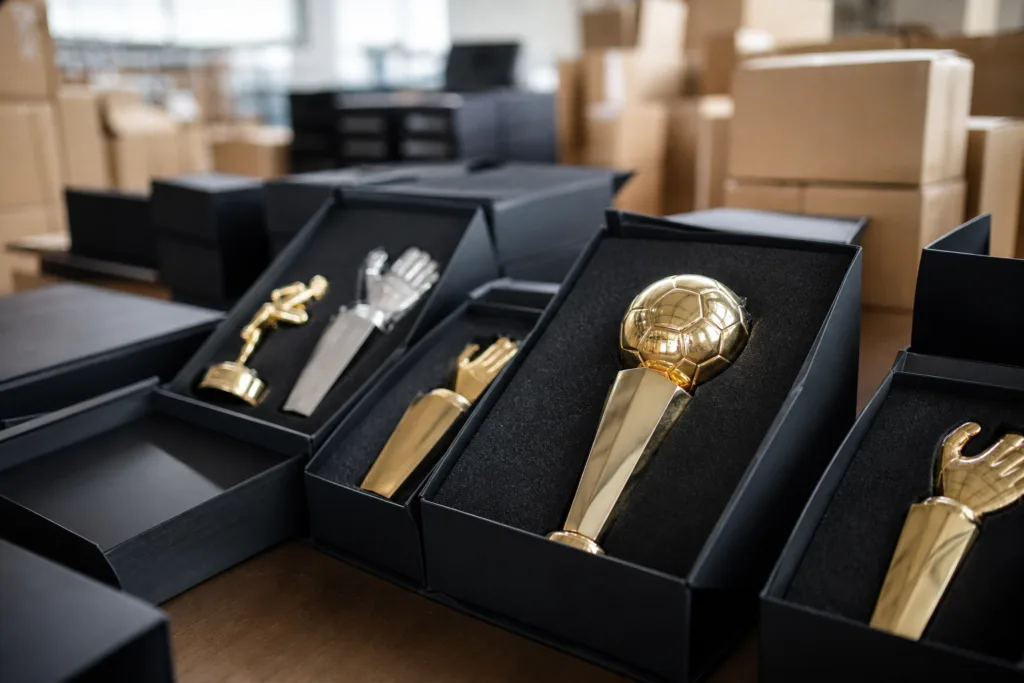
The most useful working document for custom medals and trophies planning is a master award hierarchy matrix paired with a SKU and quantity sheet. This converts creative thinking into something sourcing, operations, and manufacturing teams can all use.
Your matrix should include at least the following columns:
| Field | Purpose |
|---|---|
| Sport or category | Defines the competitive segment |
| Division | Separates age group, skill level, bracket, or region |
| Gender or age group | Clarifies parallel awards where relevant |
| Rank | Champion, runner-up, third place, MVP, special recognition |
| Ceremony type | Podium, stage, team photo, VIP handover, mail-out |
| Design family | Links each award to the correct visual system |
| Size tier | Controls hierarchy and packaging logic |
| Finish code | Keeps plating or painting consistent |
| Personalization type | Fixed plate, variable plate, engraved insert, no name |
| Packaging type | Individual box, presentation box, master carton format |
| Delivery batch | Finals, qualifiers, sponsor kits, reserve stock |
This matrix answers two major planning questions. First, which components can be shared without confusing award rank? Second, where are truly unique versions necessary? Once those answers are visible, buyers can reduce duplicate development effort and discuss manufacturing priorities more clearly.
It is also wise to separate prototype SKUs, production SKUs, and reserve quantities. Prototype SKUs support approvals. Production SKUs reflect final purchasing. Reserve quantities cover breakage, late category changes, sponsor additions, or emergency replacements. The right reserve level depends on event risk, shipping route, and replacement feasibility, so it should be confirmed by the buyer rather than assumed.
Finally, link the matrix to deadlines. Add columns or companion documents for artwork submission, approval dates, name-list cutoff, packing confirmation, shipment milestone, and venue receipt. This simple step keeps event operations synchronized with manufacturing. It also supports internal discussions around quality control for trophy projects, because inspectors can check products against a documented award structure rather than scattered email notes.
Approve Samples and Protect the Event Deadline
Multi-tier systems should follow a structured approval path. A realistic workflow typically includes concept confirmation, CAD or render review if applicable, material and finish review, pre-production sample approval, personalization proofing, mass-production signoff, final inspection, and export packing confirmation. Each stage reduces a different type of risk.
Sample approval matters more in a tiered system than in a single-product order because inconsistencies become obvious when all awards are displayed together. A slightly different base proportion, plating tone, or plaque layout may look acceptable alone, but look wrong when champion, runner-up, and category awards stand side by side. That is why reviewing family alignment during sample production is essential.
Common schedule risks include late category changes, incomplete winner-name data, rushed artwork revisions, sponsor logo updates, and packaging changes after sample approval. Another frequent issue is that organizers approve the top award carefully but treat lower tiers as routine. In reality, lower tiers often represent the largest quantities and therefore the greatest operational exposure.
Packaging deserves the same discipline as design. Metal trophies can include plated surfaces, protruding elements, and multi-part assemblies that need protection during export. Carrier guidance such as DHL’s carrier guidance for packing fragile presentation awards for shipment reinforces the value of cushioning, spacing from box walls, and suitable carton strength. For event organizers, that means the award matrix should specify not just product types but also presentation boxes, protective inserts, and shipment batch logic.
As a custom trophy manufacturer and project partner, Me Trophy can support a structured development route across mold coordination, casting, electroplating, painting, polishing, assembly, quality control, packaging, and export delivery planning. Project-specific timelines, technical limits, quantity breaks, MOQ expectations, and shipping arrangements must be confirmed for the actual order, but the planning discipline remains the same: hierarchy first, sample validation second, production release only after the system is coherent.
Conclusion
The strongest sports award programs are built on hierarchy logic, not decoration choices. When organizers define rank structure, ceremony context, shared components, size logic, finish strategy, and personalization rules before requesting quotation, they reduce SKU sprawl, protect budget efficiency, and create a more convincing award experience for every division.
If you are planning a sports trophy tier system across multiple categories, prepare an award matrix and a brief that explains ranks, ceremony moments, quantities, personalization layers, and delivery batches. Then discuss that structure with a manufacturer that can translate it into a configurable family through development, sampling, production, and export coordination. For organizers evaluating a practical solution path, the custom sports trophies page is a useful starting point for discussing a coherent award family with Me Trophy.
FAQs
1. How many trophy designs should a multi-category sports event usually have?
There is no universal number. A well-planned system often uses fewer unique designs than organizers expect by sharing bases, silhouettes, emblems, or plates across tiers. The correct count depends on category structure, ceremony needs, and the level of distinction required between champion, runner-up, and supporting awards.
2. What is the best way to separate champion and runner-up trophies without making them look unrelated?
Use the same family silhouette and change controlled signals such as height, topper detail, emblem scale, base size, or finish combination. This preserves event identity while keeping rank differences obvious in ceremony and photography.
3. Should medals and trophies be planned together for the same event?
Yes. Planning them together helps maintain a consistent visual language, finish strategy, and packaging schedule. It also prevents conflicts where medals, team trophies, and special awards compete for the same visual position in the event hierarchy.
4. When should sample approval happen for a tiered trophy system?
Sample review should happen before mass production and after the main hierarchy, finishes, and personalization approach are defined. For a tiered family, buyers should compare samples together rather than reviewing each piece in isolation.
5. What documents should buyers prepare before asking a manufacturer for quotation?
At minimum, prepare an award matrix, quantity schedule, category list, rank structure, personalization fields, target ceremony dates, and any brand guidelines or reference visuals. This gives the manufacturer enough context to discuss development routes and identify details that still require confirmation.