
Once tooling has started, a custom trophy project enters a higher-risk phase. At this point, design intent is no longer just a drawing issue; it is tied to steel, cavity geometry, engraving depth, gating assumptions, finishing access, assembly fit, and downstream packaging. In metal award programs that involve zinc alloy or copper components, die-casting, custom bases, electroplating, painting, polishing, and final assembly, even a seemingly small revision can affect appearance, fit, cost, and shipment timing. That is why trophy tooling change control matters. The objective is not to block all changes, but to manage them through a documented process tied to mold development, approvals, and validation.
For product managers, designers, and procurement teams, the key question is practical: when a trophy design change after tooling is requested, can the existing tool be modified, does the project need a new insert, or does the change trigger a fully new tool path? The answer depends on where the change sits in the part, what process it affects, and how the revised feature interacts with plating, paint, assembly, and packaging. Me Trophy should be treated as a manufacturing project partner in this evaluation, while any factory-specific capability, timing, commercial split, or tool-rework policy must be confirmed directly for the project.
Freeze the Baseline Before Tooling Release
The best post-tooling change control starts before the first tool cut. A baseline should be frozen clearly enough that both buyer and manufacturer know exactly what the tool is being built to produce. In a custom trophy program, that baseline usually includes approved 2D and 3D files, key dimensions, material callouts, logo artwork, surface finish expectations, assembly structure, base details, packaging assumptions, and any approved golden sample or master reference if one exists.
The point of commitment matters because toolmaking converts design assumptions into hard geometry. If buyers continue to issue informal edits by message thread or verbal comments after release, the result is often confusion over which revision is valid. That confusion can later appear as incorrect logo depth, an outdated event year, mismatch between metal top and base insert, or packaging that no longer fits the revised shape.
Good control starts with version discipline. Each drawing and artwork file should have a revision identifier, approval date, and named approver. It also helps to label each item as either frozen or provisional. For example, overall silhouette and logo placement may be frozen, while final carton print language remains provisional until marketing approval. This makes it easier to assess whether a later edit is a true engineering change or simply completion of an agreed open point.
Buyers should also define sign-off responsibility across design, brand, and sourcing teams before tooling begins. If three departments can independently request revisions, the manufacturer may receive conflicting instructions. A single owner for tooling release and a single owner for post-release changes usually reduces disputes.
Formal drawing/document revision control is a recognized engineering discipline, not just an administrative preference. ASME provides a structured reference on revision handling in released drawings and associated records at engineering drawing revision control for trophy tooling changes. In practice, buyers should confirm with Me Trophy which file set, sample, and approval stage become the official tooling baseline.
Classify Cosmetic, Dimensional, Structural, and Branding Changes
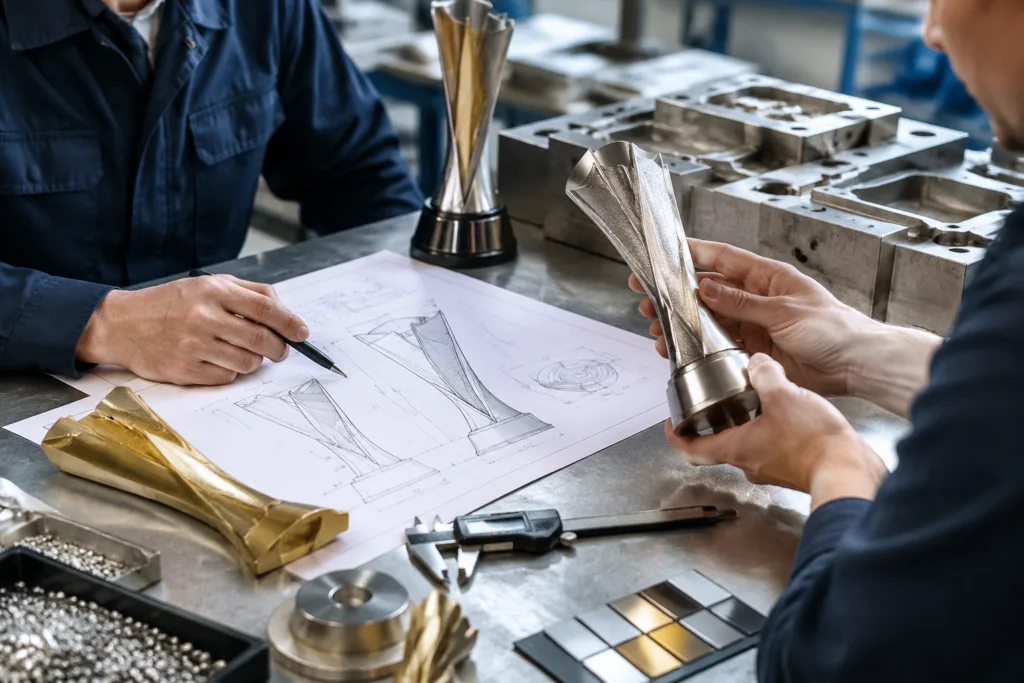
Not every revision creates the same manufacturing consequence. A practical mold rework decision starts by classifying the change correctly.
Cosmetic changes
Cosmetic revisions include texture, plating tone, paint color, polish level, or slight engraving appearance changes. Some cosmetic changes can be handled in secondary finishing without touching the tool, but others cannot. If a matte area becomes mirror polish, polishing access may change. If the trophy needs sharper recessed details for better contrast after plating, the mold or engraving insert may need modification. Paint boundary changes can also affect masking methods and inspection criteria.
Dimensional changes
Dimensional revisions include overall size, wall thickness, logo depth, text depth, fit to the base, hole position, or alignment of mating parts. These are often more serious because they may affect metal flow, shrink behavior, trim conditions, machining allowance, and assembly fit. Even a small change to a pin, boss, or recess can force a new insert if the original cavity cannot be safely reworked.
Structural changes
Structural revisions alter how the part holds together or carries load. Examples include attachment points, hidden ribs, threaded zones, pin length, weld areas if any, or balance and stability features. A sports or championship trophy with a tall upper sculpture may require careful review if the center of gravity changes or if the connection to the base is redesigned. Structural changes can also affect drop risk in packaging and long-term presentation stability.
Branding changes
Branding revisions include event names, sponsor logos, trademark updates, year changes, commemorative text, or customer artwork corrections. Some can be addressed through replaceable engraving inserts or secondary engraving operations. Others affect the main cavity, especially if the logo is sculpted into the die-cast surface rather than applied later. Procurement teams should not assume that a date change is always simple; its impact depends on how the feature was originally engineered.
Across these categories, the key procurement question is whether the change can be handled by existing tool modification, a new insert, or a full new tool. There is no universal answer. Feasibility depends on cavity location, steel condition, feature depth, draft, ejection, and finishing requirements. Buyers can use classification to speed internal decisions, but final mold modification trophy feasibility still requires Me Trophy confirmation.
Run Tool, Process, Cost, and Schedule Impact Review
Once the requested change is defined, run a formal impact review before approval. This is where many teams make the biggest mistake: they approve the design change visually without checking process consequences.
Start with tool feasibility. Can the mold be reworked safely? Does the change affect metal flow, draft, ejector layout, cavity geometry, engraving zones, shut-offs, or shrink-sensitive dimensions? Is there enough steel to cut the feature larger, or would the change require build-up, insert replacement, or an entirely new tool component? These are engineering questions, and buyers should request documented feedback rather than a simple yes or no.
Then extend the review beyond tooling. A revised feature may affect casting stability, trimming shape, machining locations, welding steps if used, electroplating coverage, painting masks, polishing access, assembly sequence, balance, packaging fit, or inspection gauges. If the trophy uses multiple materials such as a die-cast metal top with a custom base, the interface must be rechecked as part of the same review. Me Trophy’s design evaluation process is a natural point to involve engineering before a change is approved.
Buyers should ask for an impact matrix that turns an emotional design request into a cross-functional decision. A simple example is below.
| Requested change | Affected part number | Tooling impact | Process impact | Quality risk | Commercial impact | Schedule impact | Required validation |
|---|---|---|---|---|---|---|---|
| Update event year engraving | Top plate insert | Possible insert revision | Engraving or cavity update | Text legibility risk | Tool rework and sample cost require confirmation | Re-sample timing requires confirmation | Photo or insert sample |
| Increase logo depth | Main die-cast body | Cavity rework may be needed | Plating and polish appearance may change | Fill, edge sharpness, finish consistency | Added engineering and sample rerun | Possible delay to production cut-in | Finished component sample |
| Change base connection | Metal top and base | Insert or new tool area possible | Machining, assembly, packaging review | Fit and stability risk | Rework, scrap, packaging effects | Higher schedule risk | Full fit and stability sample |
This review should connect directly to tooling approval factors, because the same issues that matter before tool release also matter during revision: what is changing, what process is touched, and what evidence supports the decision. Buyers should request factory confirmation on all claims related to tool modification feasibility, revised sampling time, and any added production controls.
Approve Change Ownership and Commercial Terms
Every custom trophy engineering change needs named ownership. At minimum, the request should show who initiated the change, who evaluates technical feasibility, who approves any cost and schedule effect, and who authorizes implementation at the manufacturer. Without this, the project can enter a dangerous middle state where engineering has started a rework but commercial approval is still disputed.
A formal engineering change request and tooling revision approval workflow should include revision numbers, request date, reason for change, affected parts, required implementation point, and final approval signatures or equivalent documented approvals. It should also specify the cut-in point: for example, effective from revised sample only, from a named production order, or from all future reorders after old stock is depleted.
Commercial terms deserve the same discipline as engineering. Procurement teams should clarify who pays for mold rework, new inserts, revised samples, scrap risk, packaging changes, artwork updates, and any obsolete inventory created by the revision. They should also define how old and new revisions will be segregated to avoid mixed shipments. If production is already underway, buyers need an agreed decision on in-process goods, finished stock, and packaging that was printed to the superseded revision.
Industry practice in controlled change approval and validation is reflected in AIAG’s PPAP framework at formal change approval and sample validation after tooling revisions. While trophy manufacturing may not use PPAP formally, the core logic is highly relevant: document the change, review impact, validate the revised condition, and obtain approval before full production proceeds. Any Me Trophy-specific charge structure, timing, or responsibility split must be confirmed directly.

Re-Sample Affected Features and Interfaces
After a trophy design change after tooling, revised sampling is often necessary, but not every revision requires a full restart. The right approach is risk-based revalidation focused on affected features and interfaces.
If the change is limited to a small text update on a replaceable insert, photo confirmation or a targeted feature sample may be enough. If the revision affects a mating interface, stability, or finish-sensitive geometry, a revised component sample or full pre-production sample is more appropriate. The sampling scope should match the risk introduced by the change rather than defaulting automatically to the largest or smallest option.
Typical recheck points include logo clarity, text legibility, dimensional fit to the base, plating appearance, paint edge quality, polish consistency, assembly alignment, balance, stability, and packaging fit. If the trophy is intended for a high-visibility event, visual approval standards should be especially clear for reflective surfaces and branded details.
Procurement teams should align in advance on what evidence is needed for approval. Is high-resolution photography enough? Is a physical revised component required? Does the customer need a complete assembled sample with packaging? The project moves faster when these expectations are set before rework begins. Me Trophy’s sample review process can help buyers define what stage should be resubmitted based on the nature of the revision.
Final sampling scope, submission method, and acceptance criteria should be confirmed with Me Trophy for the specific project, especially when the change affects plated appearance, painted details, or multi-part assembly interfaces.
Update Drawings, BOMs, Masters, and Reorder Records
An approved change is not complete until all controlled records are updated. This is where many recurring trophy programs fail. The part gets changed, but the records do not, so the next reorder pulls the wrong logo file, the old assembly instruction, or an outdated packaging label.
At minimum, update the revised drawings, CAD files, bill of materials, artwork files, plating or painting specifications, inspection checkpoints, assembly instructions, packaging specifications, and any golden sample or master label used for reference. Buyers should also confirm whether ERP item notes, reorder records, and export packing records need effectivity updates.
This matters even more for annual programs, championship series, or event families with multiple variants. A one-time date change can become a repeat error if the controlled master is not updated. Similar risk appears when the same trophy body is reused across regional events with different sponsor branding. Without disciplined records, mixed revision production becomes likely.
Document effectivity by revision, approval date, order batch, and old-stock disposition. If old packaging or old inserts remain, the records should show whether they are scrapped, quarantined, or used only for a specific approved order. For future OEM/ODM repeat manufacturing, buyers should maintain a traceable revision control system and ensure that Me Trophy confirms how revision history is tracked for reorders and export deliveries.
When artwork or CAD data changes, make sure source files are updated, not just PDFs or screenshots. This is particularly important for logos, event dates, and brand assets. A practical internal reference is Me Trophy’s guidance on CAD and artwork updates, which can help teams check that the released files actually match the approved revision.
Key Procurement Questions to Ask Before Approving a Change
Before authorizing any post-tooling revision, procurement teams should ask the same core questions every time. A concise checklist helps prevent subjective decisions.
- Can the existing tool be modified? Ask what can be reworked in the current mold and what cannot.
- What specifically requires a new insert or a new tool? Request a feature-by-feature explanation rather than a general statement.
- Which dimensions, surfaces, logos, or interfaces are affected? Make the impact visible across tooling, finishing, assembly, and packaging.
- What validation is required? Confirm whether approval needs photos, a partial feature sample, a revised component sample, or a full assembled sample.
- What records will be revised? Drawings, BOMs, artwork, inspection points, packaging, and reorder masters should all be named.
- What inventory becomes obsolete? Check in-process parts, finished goods, inserts, labels, cartons, and accessories.
- What assumptions still require manufacturer confirmation? This includes tool modification feasibility, sample timing, quality control additions, and any commercial split.
Recommended Asset: Engineering Change Request Form and Impact Matrix
A practical way to improve buyer-manufacturer coordination is to use a standard engineering change request form paired with an impact matrix. This does not need to be complex, but it does need to be consistent.
Useful fields include project name, part number, current revision, requested revision, reason for change, urgency, affected components, tooling impact, process impact, quality risks, cost items, schedule impact, validation plan, commercial approval, implementation date, and a record update checklist. Buyers can also add effectivity notes such as first revised order number or last acceptable old revision batch.
This asset is especially useful when changes involve multiple stakeholders across sourcing, engineering, branding, and event operations. It creates a shared language for deciding whether a requested revision is minor, moderate, or high risk. It also reduces the chance that a supplier starts rework based on incomplete assumptions.
Near approval, buyers should reconnect the decision to the original mold development baseline so that everyone understands what changed, why it changed, and which records now define the new standard.
Conclusion
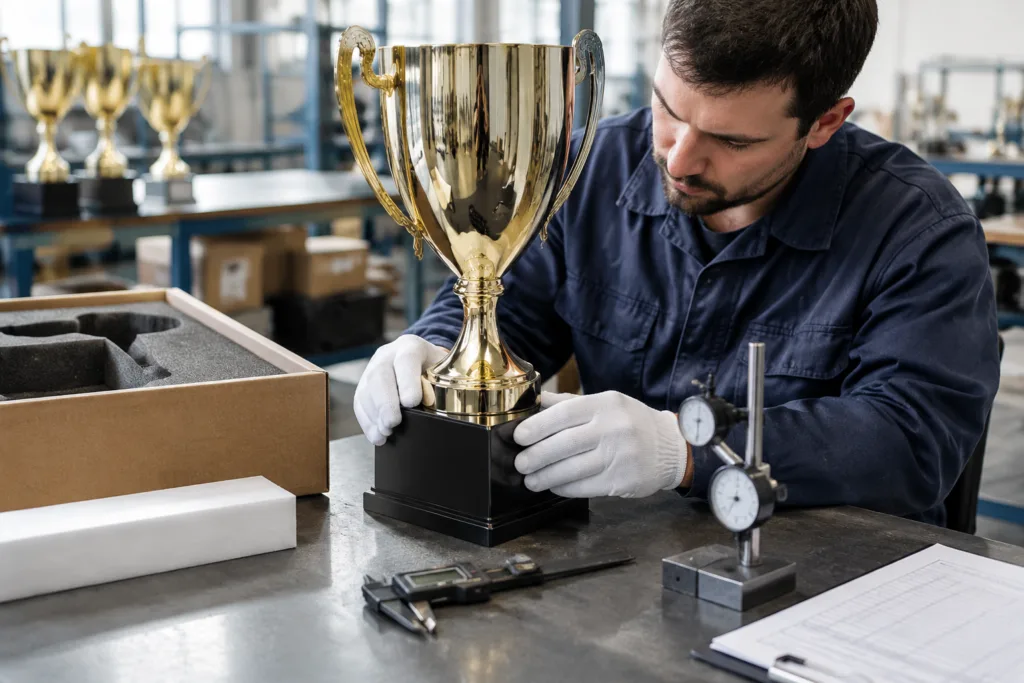
Strong trophy tooling change control protects project economics and delivery reliability after tooling starts. The best results come from freezing the baseline, classifying the change correctly, reviewing mold and process impact, approving ownership and commercial terms, re-sampling affected features, and updating all controlled records. For international B2B buyers, the practical goal is not zero change, but disciplined change.
When a post-tooling revision is handled early and transparently, teams can avoid mixed revisions, unnecessary scrap, and preventable delays. Me Trophy should be involved early in change-feasibility discussions tied to tool design, sampling, and production planning, while any factory-specific capability, timing, MOQ, chargeback approach, or implementation policy should be confirmed directly for the project.
FAQs
1. Can a trophy mold always be modified after tooling starts?
No. Some changes can be handled through rework or a new insert, while others may require a new tool. Feasibility depends on cavity location, geometry, draft, steel condition, engraving depth, and process effects. Me Trophy should confirm the specific tool modification options for the project.
2. Does every trophy design change after tooling require a full new sample?
No. Sampling should be risk-based. Minor branding or cosmetic updates may allow photo confirmation or a partial feature sample, while dimensional or structural changes often need a revised component or full assembled sample. The final validation scope should be agreed with Me Trophy.
3. Who should approve a tooling revision in a custom trophy project?
The approval path should include a named customer owner, technical evaluator, commercial approver, and manufacturing implementation owner. A documented engineering change request with revision number, approval date, and cut-in point is strongly recommended.
4. What records need updating after an approved mold modification for a trophy?
Typical updates include drawings, CAD files, BOMs, artwork, finish specifications, inspection criteria, assembly instructions, packaging specifications, golden samples, and reorder records. If these are not updated together, repeat orders can produce mixed revisions.
5. What should procurement teams clarify commercially before approving a change?
Clarify responsibility for mold rework, inserts, revised samples, scrap risk, packaging changes, artwork updates, old inventory disposition, and segregation of old versus new revisions. Any Me Trophy-specific commercial policy or cost allocation must be confirmed directly.