
Trophy base sizing is not only a styling choice. For B2B trophy projects, it is also an engineering, assembly, and logistics decision that affects how the award looks, how securely it stands, and how safely it ships. A base that appears elegant in a concept sketch can become problematic if the upper section is too heavy, the footprint is too narrow, the branding area is too small, or the packed unit becomes difficult to protect in transit. That is why early design review should consider visual proportion, stable trophy base design, attachment strategy, personalization area, and trophy base shipping weight together rather than in isolation.
For buyers evaluating custom trophy bases, the practical goal is usually threefold: create a trophy that looks proportionate, stands securely on its intended surface, and ships with lower risk of damage or unnecessary freight burden. Final engineering values, test criteria, production tolerances, and project-specific pass or fail standards must be confirmed during manufacturer review and sampling.
Start With Trophy Height, Mass, and Center of Gravity
The most useful starting point for trophy base dimensions is the complete award, not the base alone. Total height, top-section mass, decorative projections, material choice, and assembly layout all influence what base footprint and structure may be appropriate. A short compact metal award with a low profile often allows more flexibility than a tall column trophy, sculptural figurine, or asymmetrical championship cup with a heavy upper section.
In practical terms, the trophy center of gravity is the average location of the object’s weight. If too much mass sits high above the base or too far toward one side, the trophy becomes easier to tip when bumped or placed on an uneven or narrow surface. NASA provides a simple explanation of center of gravity principles here: https://www1.grc.nasa.gov/beginners-guide-to-aeronautics/generalized-center-of-gravity/. For trophies, this means taller or top-heavier assemblies usually need a wider footprint, a heavier lower section, or both to better support the overall mass distribution.
Non-specialists do not need to perform advanced calculations at the concept stage, but they should map the approximate weight distribution early. This is especially important when the design includes zinc alloy or copper castings, figurines, thick metal emblems, stacked columns, stone-like plinths, or irregular forms that place weight away from the centerline.
- Overall height: How tall will the final assembled trophy be?
- Estimated component weights: Which parts are likely to add significant mass?
- Visual top-heaviness: Does the upper section appear substantially wider or heavier than the base?
- Mounting method: Will the upper section use rods, screws, inserts, or hidden fixings?
- Expected display surface: Will the award sit on a desk, shelf, podium, banquet table, or showcase?
At this stage, exact engineering calculations, tipping criteria, and confirmation thresholds should be treated as project-specific and reviewed with the manufacturer.
Set Footprint and Proportion for Visual Balance

Once the overall height and mass direction are understood, the next decision is the base footprint. Trophy base sizing should visually support the upper structure while also improving real-world stability. A base that is too small can make the award feel under-supported and risky in handling. A base that is too large may protect stability but can make the trophy look bottom-heavy, awkward on a table, or unnecessarily expensive to pack and ship.
Buyers should review footprint from two angles: appearance and use. From an appearance perspective, the base should visually anchor the award. From a use perspective, it must fit the spaces where the trophy will actually be displayed. This is where reviewing different trophy base options becomes helpful before finalizing the configuration.
Common footprint approaches
- Round bases: Often suitable for cups, figurines, or awards with radial symmetry. They can feel elegant and compact, but the usable branding area may be more limited depending on diameter and curvature.
- Square bases: A common choice for balanced all-around presentation. They often support good visual symmetry and straightforward packaging.
- Rectangular bases: Useful when more frontal branding area is needed or when the upper structure is elongated in one direction.
- Custom-profile bases: Suitable for highly branded or sculptural projects where the base itself is part of the design language. These require more careful review of packaging efficiency and edge protection.
Custom award base proportion should reflect the intended impression. A luxury corporate award may benefit from a refined, lower visual footprint with carefully controlled mass. A championship trophy may call for a stronger and more commanding base presence. A desk award may need to balance prestige with a compact footprint that does not overwhelm the workspace.
Useful review questions include:
- Does the base visually anchor the trophy from primary viewing angles?
- Do the trophy base dimensions fit shelves, podiums, or banquet tables?
- Can the award remain stable on a narrower display surface?
- Does the base width match the visual width of the upper structure?
- Will the footprint create avoidable carton inefficiency?
When comparing base forms, it helps to review the project through the lens of size, shape, and structure rather than appearance alone.
Choose Base Height, Shape, and Edge Treatment
Base height changes both the look and the behavior of the trophy. A lower-profile base can look modern and restrained, but it may reduce available room for nameplates or serial information. A taller base can increase perceived value and visual presence, yet it may also raise the overall center of mass if the added volume is not meaningfully weighted or if it pushes the trophy height further upward.
Lower-profile versus taller bases
| Base approach | Potential benefits | Potential trade-offs |
|---|---|---|
| Lower-profile base | Cleaner silhouette, compact display, lower visual bulk | Less space for branding plates, may look too small under large top sections |
| Taller base | Greater presence, more area for winner data, stronger plinth effect | Can increase packed size, may need more handling protection, proportion must be reviewed carefully |
Shape also matters. Plinth-style blocks often suit corporate and commemorative awards. Stepped bases can create a formal, championship-oriented presentation. Tapered forms may reduce visual heaviness, while contoured edges can soften handling feel and improve perceived refinement.
Edge treatment is not only aesthetic. Corner geometry influences handling comfort, cosmetic durability, and packaging fit. Sharp corners may be visually crisp but can be more vulnerable to impact marks or require more corner protection in export packing. Softer radii may help reduce visible damage from routine handling and can simplify certain packing layouts.
Material selection and detailed manufacturability for mixed-material assemblies, metal caps, inserts, or decorative trim should be reviewed with the manufacturer. Project-specific limitations, joining methods, and finishing compatibility require confirmation.
Engineer Attachment Points and Anti-Rotation Features
The connection between the upper trophy section and the base is one of the most important engineering details in a custom award. Even a well-proportioned base can fail in use or transit if the attachment strategy is weak, misaligned, or vulnerable to loosening. For sourcing teams, this means attachment design should be reviewed alongside aesthetics, not after tooling decisions are already fixed.
Common concepts include threaded rods, screw fixing from below, internal fasteners, hidden inserts, and reinforced embedded features. The right choice depends on the weight of the upper assembly, the geometry of the interface, assembly access, and whether the award may require later service or plate updates. Exact fastening specifications, pull performance, and assembly torque requirements must be confirmed for the project.
Why anti-rotation features matter
A trophy may not only tip; it can also twist. Anti-rotation features help prevent unwanted movement between the top section and the base during handling, packing, or repeated repositioning. High-level solutions can include keyed interfaces, flats, locating pins, alignment features, and complementary geometry that limits rotation.
- Threaded connection alone: May be simple, but rotation resistance should be reviewed.
- Keyed or flat-sided interface: Helps control orientation during assembly.
- Pins or locating features: Can improve repeatability and reduce twisting risk.
- Hidden reinforcement: Useful when the visible design must remain clean.
Procurement teams should also ask how tolerance stack-up will affect fit, how assembly tools will access the fastening point, and whether the base must allow disassembly for repairs, upgrades, or replacement nameplates. Me Trophy can be positioned in the project as a manufacturing partner for mold development, casting integration, engraving and assembly, and sampling validation. Exact design parameters, insert types, and production controls require confirmation during technical review.
Reserve Space for Logos, Plates, and Winner Data
One of the most common problems in trophy development is defining personalization too late. Buyers may approve a visually attractive base, then discover there is insufficient room for logos, winner names, event dates, sponsor branding, serial identification, or multilingual text. The result is often a rushed redesign, compromised readability, or awkward plate proportions.
Base sizing should therefore include a clear plan for visible information. This can involve metal plates, engraved plaques, direct decoration, printed branding zones, or removable name elements for late-stage winner updates. If the award will be used across multiple events or annual editions, replacement access and layout consistency should also be reviewed early.
Questions to ask include:
- Can the base accept the required branding and still look proportionate?
- Will the primary audience read the text from normal viewing distance?
- Is there enough room for long names, multiple languages, or sponsor hierarchies?
- Can replacement plates be installed if winner data changes late?
- Will decoration placement interfere with fasteners or structural features?
For many OEM and ODM programs, front-face clarity matters more than maximum plate size. A plate that is technically large enough can still look crowded if the surface height is too short, the border is too narrow, or the upper structure visually blocks the viewing angle. Buyers planning logo engraving should confirm artwork area limits, finishing choices, and suitable decoration methods during design review.

Check Pack Size, Weight, and Drop Risk
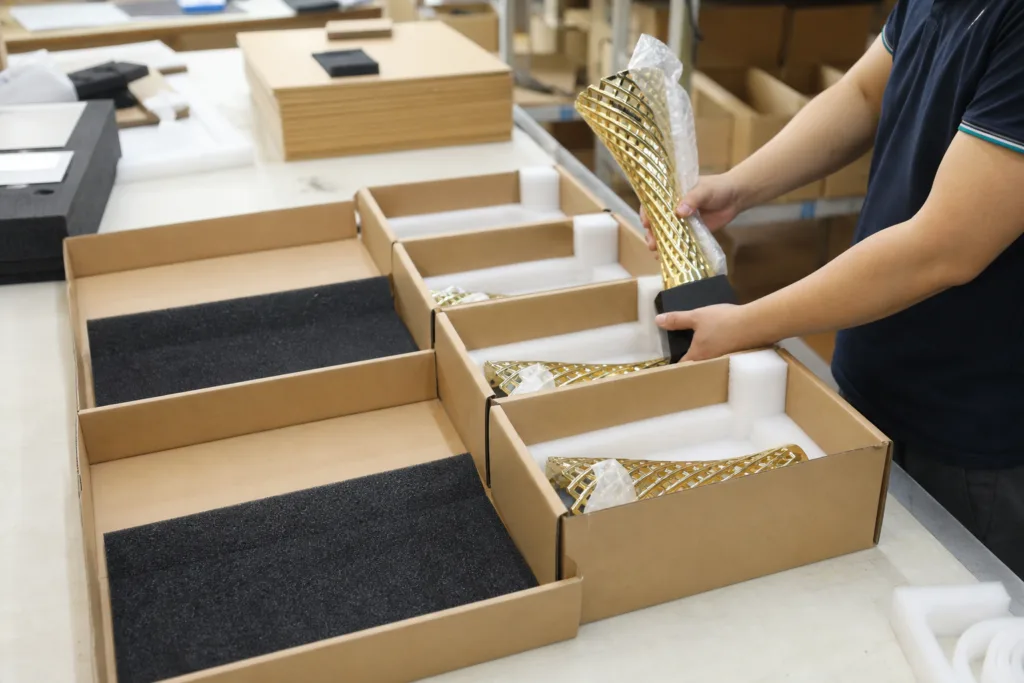
Trophy base shipping weight has a direct effect on freight cost, carton size, protective packaging needs, and handling stress. A larger or heavier base may improve in-use stability, but it can also increase the total packed weight and the force transmitted during impact if the carton is dropped. This is why shipping review should happen before the design is frozen, not after samples are approved.
Base shape also influences carton efficiency. Square and rectangular bases often fit protective inserts more predictably than irregular silhouettes. Protruding corners, stepped edges, or decorative overhangs may need additional padding or movement control. If the base is heavy relative to the upper section, internal packaging may need to prevent the assembly from shifting and damaging other components or the carton wall.
Carrier guidance can help buyers think about parcel and freight implications early. FedEx packaging guidance discusses checking packed size, weight, and shipment method thresholds before dispatch: https://www.fedex.com/content/dam/fedex/us-united-states/services/GrlPkgGuidelines_fxcom.pdf. For custom awards, this supports an early review of whether a larger base improves presentation enough to justify added shipping burden.
Drop risk should be viewed conceptually through the packaged product, not just the displayed trophy. Consider:
- Top-heaviness: Does the upper mass amplify impact if the carton falls?
- Attachment security: Can the interface resist shock and vibration?
- Corner exposure: Are base corners likely impact points?
- Movement control: Can the packed unit shift inside the carton?
- Packed orientation: Is the product safer assembled or partially separated?
For export projects, review packaging and export delivery as part of the base decision. Packaging test methods, drop criteria, and shipping performance values must be confirmed for the specific program.
Practical Sizing Worksheet for Design and Procurement Review
A structured worksheet can help internal teams align before contacting a manufacturer. It does not replace engineering confirmation, but it makes design review faster and clearer.
| Review item | What to define internally |
|---|---|
| Target height | Approximate final assembled height range |
| Estimated total mass | Relative weight of base, top section, and decorative parts |
| Top-heavy risk level | Low, medium, or high based on concept layout |
| Preferred base footprint | Round, square, rectangular, or custom profile |
| Required branding area | Logo, winner name, event date, sponsor, serial or multilingual content |
| Attachment method | Preferred fastening concept if already known |
| Anti-rotation need | Whether orientation control is required |
| Target display surface | Desk, shelf, podium, counter, stage table, or display case |
| Carton constraints | Any shipping size or packed weight concerns |
| Shipping sensitivity | Domestic parcel, export courier, consolidated freight, event rush shipment |
An internal center-of-gravity sketch can also be useful. Even a simple side-view concept showing the likely weight concentration helps teams discuss whether the current stable trophy base design is realistic before sampling.
Common Base Sizing Mistakes to Avoid
- Choosing the base only by appearance: This can lead to tipping risk, poor shelf fit, or attachment redesign after sampling.
- Underestimating the mass of metal upper parts: Cast figurines, medallions, and thick top ornaments can quickly shift the center of gravity upward.
- Leaving too little branding space: Plates and logos may become cramped, reducing readability and perceived quality.
- Ignoring narrow display surfaces: A trophy that is stable on a large studio table may be less secure on a reception desk or podium shelf.
- Using weak attachment geometry: A visually strong award can still fail if the connection rotates, loosens, or lacks reinforcement.
- Approving design before packaging review: This can create avoidable freight cost, oversized cartons, cosmetic damage risk, or rework in export packing.
For OEM and ODM trophy projects, these mistakes often increase cost through redesign, tooling changes, packaging modification, or delayed approvals rather than through the base material alone.
When to Request a Base Engineering Review With a Manufacturer
Buyers should involve a manufacturer early when the trophy is tall, top-heavy, asymmetrical, highly customized, built from multiple metal components, or intended for export shipment in volume. These conditions increase the importance of engineering review because visual decisions and production feasibility become tightly linked.
A useful review package for the manufacturer should include:
- Concept drawings: Front, side, and perspective views if available
- Approximate dimensions: Overall height and major widths
- Target finish: Electroplating, painting, polishing, textured effects, or mixed finishes
- Decoration requirements: Logos, plates, engraving zones, winner data, and language needs
- Assembly expectations: Fully assembled, partially assembled, or serviceable construction
- Packaging concerns: Export shipment, event deadlines, courier handling, or carton restrictions
At this stage, the pillar page for custom trophy bases is a useful reference point when comparing footprint styles, structures, and commercial practicality. Me Trophy can support discussions around custom bases, mold development, casting, finishing, assembly, quality control, packaging, and export coordination as a manufacturing and development partner. Any company-specific capability details, engineering limits, sampling timelines, or validation methods require confirmation for the project.
Conclusion
The most reliable approach to trophy base sizing is to start with total height and mass distribution, then balance visual proportion with stability, engineer the attachment interface, reserve sufficient space for branding, and review shipping impact before release. In other words, good trophy base dimensions should support appearance, function, assembly, and logistics at the same time.
For procurement teams, a simple internal worksheet can reduce revision cycles and improve supplier discussions. For more complex projects, request a base engineering review before sampling and production so the final design can be checked for proportion, structure, manufacturability, and packing practicality.
FAQs
1. How do I choose trophy base dimensions for a tall metal award?
Start by reviewing total height, approximate component weights, and whether the upper section is visually or physically top-heavy. A taller metal award often needs a broader footprint, more supportive lower mass, or a more secure attachment method. Exact sizing and stability criteria should be confirmed during engineering review and sampling.
2. What is trophy center of gravity in simple terms?
It is the average location of the trophy’s weight. If too much mass sits high or off-center, the award becomes easier to tip or twist. This is why base footprint, lower mass distribution, and attachment design all matter in stable trophy base design.
3. How much branding space should a custom award base include?
The base should be planned around the actual logo, winner name, event date, sponsor hierarchy, and language requirements before the design is finalized. Space should also be reviewed for readability, plate replacement access, and late-stage winner updates. Final artwork area limits require confirmation with the manufacturer.
4. Does a heavier base always make a trophy better?
No. A heavier base can improve perceived stability, but it may also increase shipping weight, impact force during drops, and packaging cost. The right solution balances appearance, stability, handling, and freight practicality rather than maximizing base mass.
5. When should I ask a manufacturer to review the trophy base design?
Request a review early if the award is tall, irregular, top-heavy, highly customized, or intended for export shipment in volume. Early review helps identify attachment risks, branding-space conflicts, and packing issues before tooling or sample approval.