
Fabricated copper trophy design differs fundamentally from cast trophy development. Instead of filling a mold with molten metal to create a solid or thick-walled form, fabrication builds the award from sheet, tube, and formed subcomponents that are bent, rolled, joined, reinforced, finished, and assembled. For industrial designers and premium-award developers, that difference matters early. A concept may be better developed as a custom copper trophies project when it benefits from a lighter hollow structure, visible sheet direction, folded geometry, wrapped volume, or a more handcrafted metal character than a cast surface usually provides.
A sheet-based route can also open useful design possibilities for open silhouettes, faceted forms, elongated vertical awards, and mixed-material assemblies where the copper shell works with a base or internal support. But fabrication is not simply a cheaper or easier substitute for casting. It introduces its own rules around panel breakdown, seam planning, reinforcement, surface control, heat effects, and finishing sequence. Feasibility, repeatability, and final presentation quality must be reviewed against the actual concept, target quantity, finish expectation, and mounting method.
This guide explains when a sheet copper trophy, formed copper award, or hollow copper trophy concept is usually worth evaluating, how to design it for manufacturing repeatability, and which capability details should be confirmed with Me Trophy as a custom trophy manufacturer and OEM/ODM project partner.
When Fabrication Fits a Copper Trophy Concept
Fabrication is often the stronger route when the desired form language depends on construction logic rather than monolithic mass. In practical terms, that means the concept gains value from being built out of planes, shells, wraps, and joined sections.
Common scenarios include large but visually light awards, open-frame geometries, folded surfaces, tapered tubes, wrapped cones, faceted sculptures, and forms with directional brushing or intentionally visible metal grain. In these cases, a copper trophy fabrication approach may preserve the design intent better than casting because the final object reads as worked sheet metal rather than as a cast replica of sheet-like geometry.
Cast development, by contrast, is often better suited to deeply modeled relief, highly integrated sculptural mass, organic transitions without obvious joints, and repeatable reproduction of complex textures. Fabrication generally favors forms that can be understood as panels, shells, rings, channels, tubes, or fabricated subassemblies. Casting generally favors continuous volume.
Buyers comparing routes should ask a simple question: what should the award look like it is made from? If the answer is a folded, formed, wrapped, rolled, or assembled copper object, fabrication deserves serious review. If the answer is a dense sculptural figure with continuous depth and no seam logic, casting or a hybrid solution may be more appropriate.
A practical concept screening framework is below.
| Concept feature | Fabricated route often fits when | Cast route often fits when | Hybrid option |
|---|---|---|---|
| Overall size | Form should stay lighter with hollow construction | Compact solid presence is acceptable | Fabricated body with cast detail accents |
| Geometry language | Planar, folded, tubular, wrapped, faceted | Organic, sculpted, relief-heavy | Cast emblem on fabricated shell |
| Surface character | Directional grain or handmade transitions are desired | Uniform cast skin is preferred | Mixed visual hierarchy |
| Revision logic | Panel breakdown may allow selective changes | Whole sculptural form is fixed by tooling route | Revise one subsystem only |
| Openings and voids | Large open silhouettes are central to the design | Voids are secondary or decorative | Fabricated frame with cast centerpiece |
For procurement teams, the decision is not about forcing one process across all concepts. It is about identifying which designs should be reviewed as fabricated, cast, or hybrid assemblies during early design evaluation. That review should confirm what details are realistic, where joins may fall, how the base is engineered, and whether the desired finish can be maintained across the batch.
Choose Sheet Form, Thickness, and Reinforcement Strategy
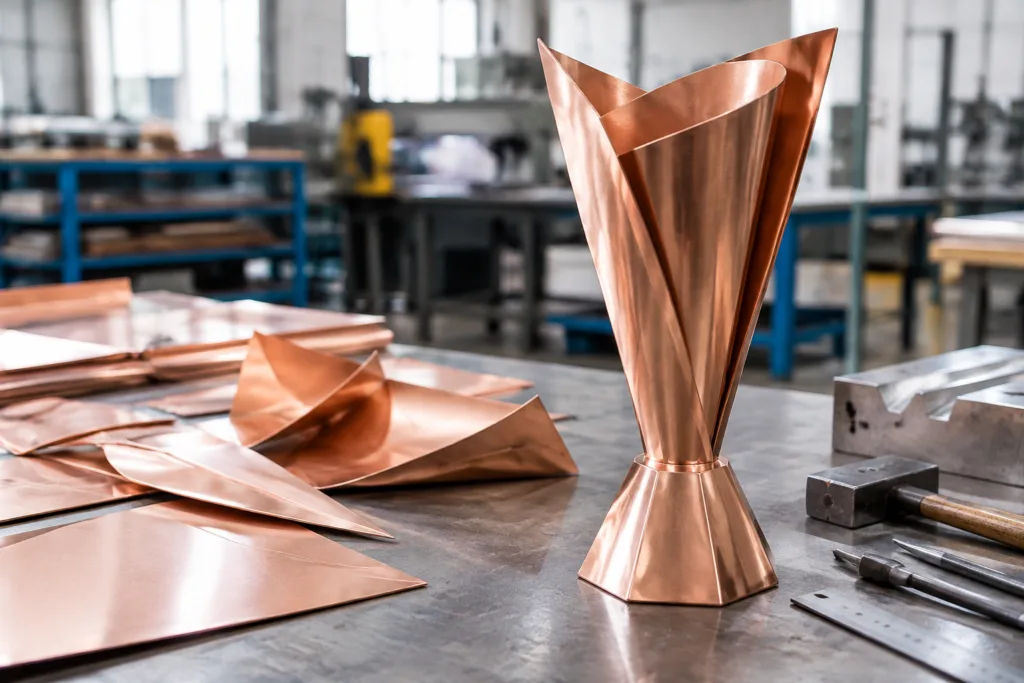
Most fabricated copper awards begin with a choice between flat sheet, tube, wire-form support elements, or a combination of fabricated subcomponents. The intended silhouette normally drives that decision. Broad faces and folded planes may suit sheet blanks. Cylindrical or conical forms may start from rolled sheet or tube-based structures. Tall or asymmetrical trophies often require a combined strategy, with external copper skin and hidden internal reinforcement.
Thickness selection affects more than strength. It influences dent resistance, edge feel in the hand, bending behavior, springback, weight distribution, seam formation, and the joining method that may be practical. Thicker material can improve perceived solidity and edge quality, but it may also change bend radii, increase forming resistance, and alter how crisp transitions appear. Thinner material may support lighter hollow forms, but it can become more sensitive to distortion, local wave, and handling marks. Exact thickness recommendations must be confirmed against each project’s size, shape, finish, and base connection.
Reinforcement planning is especially important in a custom copper sculpture award with larger unsupported faces or extended vertical height. Designers should not assume that the visible shell alone will provide stable, repeatable geometry. Internal support may be necessary to keep the award upright, maintain alignment during joining, and reduce deformation during transport.
Typical reinforcement strategies include:
- Folded returns behind exposed edges to increase stiffness and improve edge feel.
- Hidden ribs placed behind broad faces to reduce oil-canning or visible flex.
- Internal frames that carry the structural load when the outer copper skin is mainly aesthetic.
- Threaded inserts for controlled assembly to base hardware or mixed-material features.
- Localized backing plates at mounting points, logo attachments, or high-stress interfaces.
These choices are directly tied to the approved size, shape, and structure of the award. For example, a slim vertical shell with a high center of gravity may require hidden support concentrated near the base interface. A wide open form with cantilevered elements may need reinforcement at transition points where the geometry appears visually light but mechanically vulnerable.
Procurement teams should request confirmation on three specific items during review: where structural load travels, how reinforcement affects visible wall thickness at edges, and whether any hidden support creates restrictions for personalization, lighting, or insert features later in the program.
Plan Bends, Curves, Seams, and Accessible Joints
A well-designed fabricated award is usually not a single impossible shell. It is a deliberate assembly of manufacturable parts. Designers improve project outcomes when they break the object into panels and subassemblies that match the chosen forming methods.
Straight bends are generally more predictable than compound curvature. Rolled curves may be achievable when the form behaves like a developable surface. Double-curved or heavily sculpted geometry often becomes more realistic when divided into multiple sections rather than forced from one blank. Relief cuts, corner treatments, and controlled overlaps may also be needed to form sharp transitions without tearing, buckling, or visible strain in sensitive areas.
Bend radii deserve special attention. Very tight bends may change the visual crispness, stress the material, or affect edge consistency after finishing. Larger radii may look cleaner and repeat more reliably, but they alter the aesthetic. That is why critical edges should be identified in drawings, renders, or CAD comments before sampling begins.
Seam strategy is another core design decision. In fabrication, seams are not just manufacturing leftovers. They are part of the product architecture.
- Hidden seams may be placed on undersides, rear faces, edge returns, or inside shadow lines.
- Integrated seams can follow natural feature transitions, fold lines, or geometry breaks.
- Celebrated seams may be intentionally exposed when the concept embraces a crafted metal aesthetic.
Designers should also leave accessible joining zones. Depending on the geometry and project requirements, joining may involve soldering, brazing, welding, or mechanical fastening, but the specific route should not be assumed without manufacturer review. Access affects both build feasibility and cosmetic outcome. A joint that is easy to reach may finish more consistently than one hidden deep inside a narrow shell. Conversely, a visually critical front face may need to be kept free of join lines even if that complicates the subassembly sequence.
From a buyer’s perspective, the most repeatable forms are usually those with clear panel logic, moderate curvature, consistent edge conditions, and seams located in controlled non-focal areas. Greater hand-finishing variation may appear where compound transitions meet, where highly polished surfaces cross joined zones, or where sharp points and thin edges are blended after assembly.
During supplier review, ask for a joint-detail diagram showing panel breaks, probable access points, and where subtle seam evidence may remain after finishing. That one document can prevent long approval loops later.
Control Heat Effects and Surface Direction
Copper is visually sensitive. That sensitivity is part of its appeal, but it also means fabrication and joining can influence color, flatness, edge sharpness, and visible grain direction. Designers should define surface intent early rather than treating finish as a final cosmetic step.
For a brushed or satin award, sheet direction matters. If adjacent panels carry grain in conflicting directions, the form may look inconsistent even when assembly is accurate. For polished surfaces, local waviness, heat tint, and post-join rework can become more visible because reflection exaggerates small irregularities. For intentionally handcrafted finishes, controlled variation may be acceptable, but it still needs a shared approval standard.
Heat from joining can produce several effects: localized discoloration, slight warping, softened crispness at nearby edges, and extra refinishing work to restore surface continuity. On a highly reflective formed copper award, these effects can be more noticeable than on a matte or textured finish. The manufacturing sequence therefore matters. Some surfaces may be pre-finished, then protected and joined. Others may need final finishing only after assembly. The best sequence depends on geometry, access, and the chosen visual standard, and it should be confirmed for the project.
When buyers specify finish, they should define both the target look and the acceptable variation range. Useful approval language can include:

- Primary viewing distance for inspection.
- Main presentation faces versus secondary hidden faces.
- Whether grain direction must align across parts.
- Whether minor hand-finished variation is acceptable near concealed joins.
- Whether mirror-like reflectivity is required or a softer premium satin is preferred.
It is also sensible to approve a master sample, especially when the project combines visible seams, handmade finishing, and copper’s naturally variable visual response. A master sample gives sourcing teams a practical benchmark for what counts as acceptable surface behavior in production.
For finish development, capability details around brushing and polishing should be reviewed alongside the fabrication plan, not after it. This is where procurement and design teams often discover that a beautiful rendering needs a different panel split, softer radius, or revised grain direction to remain realistic in production.
Integrate Bases, Inserts, and Personalization

A fabricated copper shell should never be designed in isolation from its base. Stability, transport safety, and presentation quality all depend on the interface between the award body and the supporting structure.
Base integration can involve concealed fasteners, internal threaded connections, sleeves, mounting rods, hidden plates, or welded and fabricated support structures inside the copper form. The right approach depends on the center of gravity, shell thickness, shipping method, and whether the award will be handled frequently during ceremonies. A visually light hollow copper trophy may still need a carefully engineered internal support path to achieve reliable upright presentation.
Common base materials include stone, metal, wood, and hybrid constructions. Each changes the mounting strategy. Stone may benefit from precisely located hardware and backing structures. Wood may call for concealed threaded inserts and controlled compression. Metal bases can sometimes integrate more directly with a fabricated shell, but galvanic, finishing, and appearance considerations still need review. For many concepts, custom trophy bases should be developed as part of the same engineering package rather than as an afterthought.
Personalization also needs early planning. Logos, nameplates, engraved zones, etched plaques, printed elements, and mixed-material inserts should be placed where they do not weaken the shell or conflict with internal reinforcement. On thin or formed faces, a large cutout or deeply engraved area may change local stiffness or create unwanted read-through on the visible surface. Nameplate recesses, bonded plaques, or separate emblem components may therefore be preferable to direct intervention on a primary presentation face.
When the project moves from concept exploration to supplier review, buyers should return to the pillar page for custom copper trophies and confirm how body construction, base engineering, logo application, and final finish will work together. Me Trophy can be positioned as the manufacturing partner for that discussion, but exact fabrication capability, achievable details, and project-specific feasibility require confirmation against the approved drawings and samples.
Prototype and Approve the Handmade-to-Repeatable Balance
Successful copper fabrication programs usually pass through multiple approval stages. A render alone rarely answers the critical manufacturing questions. Teams should move from concept sketches and 3D files into flattening logic, mockups, appearance studies, and pre-production review with enough detail to expose seam strategy, reinforcement, and finish risk.
Useful prototype and approval tools include:
- Sketches and annotated renders to define design intent and focal surfaces.
- 3D CAD files to test proportions, panel breakdown, and base interface logic.
- Flattening studies to evaluate whether surfaces can realistically be formed from sheet.
- Soft prototypes or mockups to validate scale, silhouette, and assembly sequence.
- Appearance samples to approve color, grain direction, seam visibility, and edge treatment.
- Pre-production samples to confirm the repeatable build route.
This is especially important for premium awards that need small-batch consistency while still preserving a handcrafted premium feel. Not every handmade characteristic should be eliminated. The key is to decide where variation is acceptable and where it is not.
A practical fabrication feasibility checklist should cover the following procurement checkpoints:
- Which surfaces are visually critical at ceremony viewing distance.
- Which seams must be hidden completely and which may remain subtly readable.
- Which edges need a crisp machined appearance versus a softer hand-finished look.
- Which mounting points carry structural load.
- Which finishes require master-sample approval.
- Which dimensions are functionally critical for fit to base or inserts.
- Which areas may show minor handmade variation without affecting acceptance.
Buyers should also ask for a joint-detail and assembly diagram during sample production. That review helps align expectations between industrial design, sourcing, and the manufacturer before production planning proceeds too far.
Most importantly, repeatability limits, acceptable variation range, and final workflow should be confirmed with Me Trophy during sampling. A design that looks straightforward in CAD may require adjustments in panel split, reinforcement, or surface finish to reach a reliable production standard. Early confirmation is usually more valuable than late cosmetic correction.
Conclusion
Strong fabricated copper trophy design starts by accepting fabrication as a design language, not just a manufacturing fallback. When a concept benefits from hollow construction, directional sheet surfaces, folded geometry, tubular volume, or crafted seam logic, a sheet-based route can translate the idea more honestly than a cast interpretation.
The best results come when seams, reinforcement, base interfaces, surface direction, joining access, and approval checkpoints are defined from the beginning. That is how a sculptural idea becomes a manufacturable program rather than a one-off experiment. For procurement teams, the goal is not only visual impact but repeatable presentation quality across the approved quantity.
If you are evaluating a sheet copper trophy, formed copper award, or hybrid concept, share drawings, renders, or reference samples with Me Trophy for development feedback and capability confirmation. Project-specific details such as feasible construction method, finish behavior, achievable detail level, and production workflow should be reviewed directly against the design before approval.
FAQs
1. When is a fabricated copper trophy design better than a cast design?
Fabrication is often better when the concept depends on hollow lightweight construction, folded or wrapped geometry, open silhouettes, visible sheet direction, or a handcrafted metal character. Casting is often better for continuous sculptural mass, deep relief, and highly integrated organic detail. Some projects work best as hybrid assemblies.
2. How should buyers choose sheet thickness for a copper award?
Thickness should be chosen according to the award’s size, shape, dent-resistance needs, edge treatment, reinforcement plan, and base connection. Because these factors interact, exact thickness should be confirmed with the manufacturer during technical review rather than assumed from appearance alone.
3. Will seams always be visible on a sheet copper trophy?
Not always. Seams can often be hidden along edges, undersides, rear faces, or natural feature transitions. However, some seam evidence or hand-finishing variation may remain depending on geometry, finish reflectivity, and the chosen joining method. Critical seam locations should be reviewed in sampling.
4. What should be approved before production of a formed copper award?
Buyers should approve the panel breakdown, reinforcement approach, base interface, visible finish standard, grain direction if relevant, acceptable seam visibility, personalization method, and a master sample or appearance sample where possible. These approvals help align handcrafted character with repeatable quality expectations.
5. What capability details should be confirmed with Me Trophy for copper trophy fabrication?
Project-specific feasibility should be confirmed for forming method, achievable detail level, joining approach, reinforcement strategy, surface finish sequence, base mounting structure, personalization integration, acceptable variation range, and sample approval workflow. These details depend on the exact design and should not be assumed generically.