
Export packaging for metal trophies is not only about keeping a product presentable when it arrives. It is a project control step that helps prevent metal award transit damage, protect assembled parts, and reduce avoidable claims during international shipping. For buyers managing launch schedules, events, or distributor replenishment, a clear trophy packaging test process should sit alongside design approval and production release. When Me Trophy supports a project, the packaging work should be handled as part of the wider packaging and export delivery workflow, with route review, packed-sample checks, and sign-off criteria defined before full shipment approval.
The key question is not whether a carton looks strong on paper. The question is whether the full pack-out can survive the real route: factory handling, warehouse stacking, export consolidation, ocean or air movement, destination sorting, and last-mile delivery. A practical export carton test trophies plan should therefore examine the trophy itself, the base, plaques, loose accessories, carton closure, and how the package behaves when it is dropped, vibrated, compressed, or rehandled. The goal is a packaging approval record that can be reviewed by procurement, QA, and logistics before release.
1. Map trophy damage risks across the distribution route
Before any trophy drop test packaging plan is written, the route should be mapped from finished goods packing to final delivery. Metal trophies often look rigid, but assembled award sets can still fail at weak points such as sharp edges, protruding features, adhesive joints, plated surfaces, and loose accessory pockets. Route mapping turns these risks into test priorities.
| Route hazard | Typical trophy risk | Packaging control to review |
|---|---|---|
| Factory handling | Corner scuffing, surface contact marks, part shift inside the carton | Inner wrap, fixed position insert, pack-out discipline |
| Warehouse stacking | Carton crush, base deformation, carton bulging at weak seams | Carton grade, closure method, stack orientation |
| Transport vibration | Loose plaque, abrasion, fretting between parts | Custom insert testing, restraint of accessories, gap control |
| Humidity exposure | Print damage, carton weakening, possible finish concerns from condensation | Outer packaging choice, barrier bag use, storage condition review |
| Last-mile delivery | Corner impact, drop from hand height, repeated rehandling | Drop test height and orientation selection, handle marks, carton markings |
The route risk map should also note whether shipments are moving by parcel, palletized freight, air cargo, or mixed consolidation. A carton that survives pallet movement may still fail parcel handling. Likewise, a package designed for one-piece presentation may need more restraint if the trophy is shipped with a separate base, a removable plaque, or accessory hardware.
2. Approve inner protection, inserts, and accessory restraint

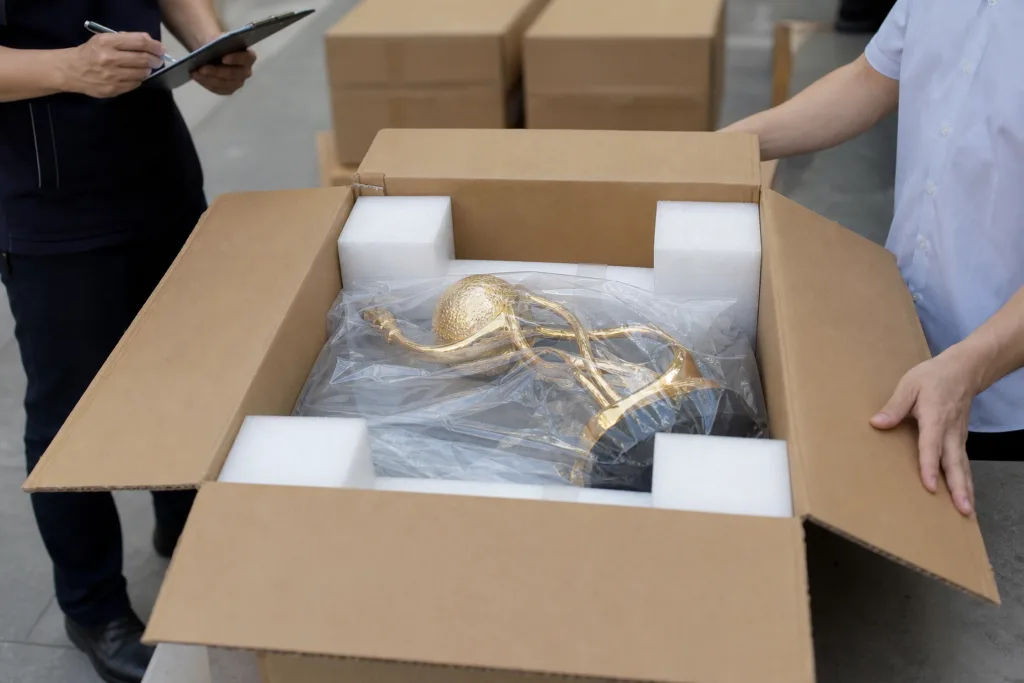
Inner protection is where many packaging failures start. Even when the outer carton is strong, a trophy can move enough inside the pack to damage plating, chip paint, or crack a fragile joint. This is why custom insert testing should be treated as a core approval step, not an optional detail. For buyer-led projects, Me Trophy can align packaging development with private-label packaging requirements so the pack-out reflects the brand, the product structure, and the intended route.
What to check in the inner pack
- Surface contact points: confirm whether foam, molded pulp, or other inserts touch only approved areas and do not rub plated or painted finishes.
- Part restraint: confirm that the base, plaque, medal, or loose hardware cannot shift during handling or vibration.
- Orientation control: check that the trophy always returns to the correct position after opening and resealing.
- Accessory separation: keep screws, cards, certificates, and spare parts from contacting the main trophy surface.
- Repeatability: confirm that the insert can be packed the same way by different operators without changing fit or protection.
For some projects, a simple wrapped tray is enough. For others, especially where surface finish or multi-piece assembly is sensitive, a shaped insert may be needed. The right answer depends on the trophy geometry, the finish specification, and the route. If a buyer asks for sample changes after the first test, the packaging update should be reviewed together with the decorated sample, because small changes to the form factor can affect the fit of the entire pack.
It is also useful to ask whether the insert protects only against impact, or whether it also prevents friction and part migration. A trophy that passes a single drop event can still fail after repeated vibration if the insert allows micro-movement. That is why packaging teams should look at the full sequence, not just one isolated test result.
3. Define carton, seal, label, and pack-out requirements
Once the inner protection concept is stable, the outer shipper should be specified with the same discipline. Carton strength, seam closure, orientation marks, and packing consistency all affect whether the approved sample can be repeated in production. This is the stage where a project team should translate product approval into a practical pack-out instruction.
A useful approval document usually covers the following fields:
| Pack-out field | What to specify | Why it matters |
|---|---|---|
| Carton format | Single unit or multi-unit shipper, export or retail outer, and whether the carton is master packed | Controls handling load and stacking behavior |
| Closure method | Tape pattern, adhesive method, or other approved closure approach | Reduces opening risk during transit |
| Orientation marks | Up arrows, fragile marks, and any buyer-specific handling instructions | Supports correct handling and sorting |
| Pack count | Units per carton, accessory count, and the exact contents list | Prevents missing parts and pack-out mismatch |
| Label set | Buyer mark, SKU reference, carton number, destination details, and any required shipping marks | Helps warehouse and customs processing |
For export shipments, the carton label should be reviewed as part of the approval process, not after production is complete. That review should confirm the marks are consistent with the buyer’s paperwork, and that the carton information is readable, durable, and placed in the agreed position. If a project includes private branding or separate destination instructions, the pack-out should be tested in the exact combination that will ship.
Pack-out consistency matters as much as the carton itself. If one operator packs the insert slightly loose, the package may fail even though the approved sample passed. For that reason, the standard work instruction should describe the layout, sequence, and final visual check. If a change request affects the structure, artwork, or accessory count, the pack-out should be reopened for review before release.
4. Plan drop, vibration, compression, and handling checks
A formal trophy packaging approval process should use a test plan that matches the actual distribution risk. For many export projects, the right approach is to define which hazards need to be simulated before production release. Two widely used frameworks are ASTM D4169 performance testing for shipping containers and systems and the ISTA 3A drop and vibration test sequence. These references are useful because they show how packaging validation can combine drop, vibration, compression, and route simulation rather than relying on visual inspection alone.
The exact test severity, sequence, and pass criteria must be confirmed for the project. A trophy that travels by parcel service may need a different profile from one that moves as palletized export freight. Similarly, a tall metal award with a narrow base may need additional orientation checks compared with a compact cast piece. The test plan should therefore be written around the finished packed product, not the component parts alone.
What the test plan should answer
- Which route is being simulated: parcel, mixed freight, or export consolidation?
- Which package faces and orientations are most vulnerable to impact?
- Does the insert keep the trophy centered after repeated movement?
- Does the carton stay closed after handling and compression?
- Are finish marks, dents, chips, or loose parts present after testing?
During validation, the QA team should record the exact packed state before testing and compare it with the post-test condition. If a failure appears, the root cause should be documented clearly: impact at a weak corner, movement within the insert, seam opening, or accessory collision. The purpose is not just to pass a test, but to understand which design change prevents the next failure.
5. Run a packed-sample approval and record results
Packaging approval is strongest when the buyer signs off on a real packed sample, not just a drawing or a carton spec sheet. For trophy programs, Me Trophy can align the package review with sample production, so the object, insert, carton, and labels are evaluated together. That is often the fastest way to catch a mismatch between the visual design and the logistics reality.

A useful packed-sample approval should include:
- photos of the sample from multiple angles before sealing;
- a clear record of the contents, orientation, and pack-out method;
- test logs showing what was checked and in what order;
- notes on any failure points, including minor scuffing or movement;
- buyer comments and the final sign-off decision.
If the sample passes, the signed record should become the reference for production. If it fails, the revision should be made before the order is released. In many projects, the most efficient review is a three-way check between procurement, logistics, and the manufacturer’s quality team, because each group sees a different risk. Procurement protects the commercial commitment, logistics protects the route, and quality protects the finished product.
At this stage, the buyer should also confirm what happens if a future batch requires a change. A small adjustment to the insert cutout, accessory bag, or outer carton can alter the complete pack-out. That is why the approval record should be treated as a controlled document. If the project includes multiple SKUs or markets, each variation should be reviewed separately rather than assuming one approved pack fits all.
When buyers need broader project coordination, Me Trophy can support the packaging conversation as part of quality control and release review, so packaging sign-off is connected to the production record, not handled as a loose afterthought.
6. Use transit feedback for corrective packaging changes
Even a good packaging plan can improve after real shipment data is collected. Damage reports, customer feedback, and warehouse observations should be gathered in a structured way so the next round of packing changes is based on evidence rather than guesswork. If repeated marks appear in the same area, the cause may be inside the pack, not on the shipping route. If cartons arrive crushed but the product is intact, the improvement may be in the outer shipper rather than the insert.
The most effective corrective loop usually asks four questions: where was the damage found, what was the visible symptom, what route condition likely caused it, and what packaging revision should be tested next? That could mean stronger restraint, a different insert geometry, improved closure, or a revised pack-out instruction. For ongoing programs, Me Trophy can support OEM manufacturing support so the packaging revision is coordinated with the product build and assembly method.
Transit feedback should also be fed back into future sample review. If a buyer reports that cartons are arriving with corner damage after consolidation, the next sample should be challenged against that same risk. If the issue is vibration-related, the next validation should focus on movement control inside the insert. This is the practical value of export packaging approval: each shipment makes the next one easier to validate.
For procurement and sourcing teams, the best outcome is a repeatable system. The approved carton spec, label set, insert design, and sign-off record should all be retained with the order file. That way, future reorders can be compared against the approved baseline, and any deviation can be reviewed before release.
Practical buyer checklist before shipment release
- Confirm the route risk profile and the expected handling sequence.
- Review the inner protection concept for movement, abrasion, and accessory restraint.
- Approve carton closure, labels, and pack-out instructions for each SKU.
- Validate the package with an appropriate drop, vibration, or compression sequence.
- Sign off only after the packed sample, photos, and test record match the buyer’s criteria.
- Keep a corrective action log for any damage reported after transit.
If your team wants Me Trophy to support the next packaging approval step, start with the approved product structure, destination route, and sample pack-out requirements. That gives the project team a practical basis for deciding what to test, what to document, and what to release.
Frequently asked questions
What should a trophy packaging test prove before export release?
It should prove that the packed trophy can survive the expected route without visible damage, loose parts, carton failure, or unacceptable movement inside the pack.
Which damage risks matter most for metal trophies in transit?
Impact, vibration, stacking load, humidity exposure, and last-mile rehandling are the main risks, especially for plated, painted, or multi-piece awards.
Do drop tests alone approve export carton packaging?
No. Drop testing is important, but export approval should also consider vibration, compression, closure integrity, and pack-out consistency.
What should a packed-sample approval record include?
It should include photos, pack-out details, test logs, failure notes, and final buyer sign-off criteria so the approved setup can be repeated in production.
How should transit damage feedback be used after shipment?
Use it to identify the failure mode, confirm the likely route cause, and revise the insert, carton, or closure method before the next shipment.